Abuja Airport's Electric Shuttle Faces Tough Times with Low Passengers
The electric shuttle at Abuja Airport is facing challenges attracting passengers. Despite its eco-friendly goals, many travelers prefer other transport options.
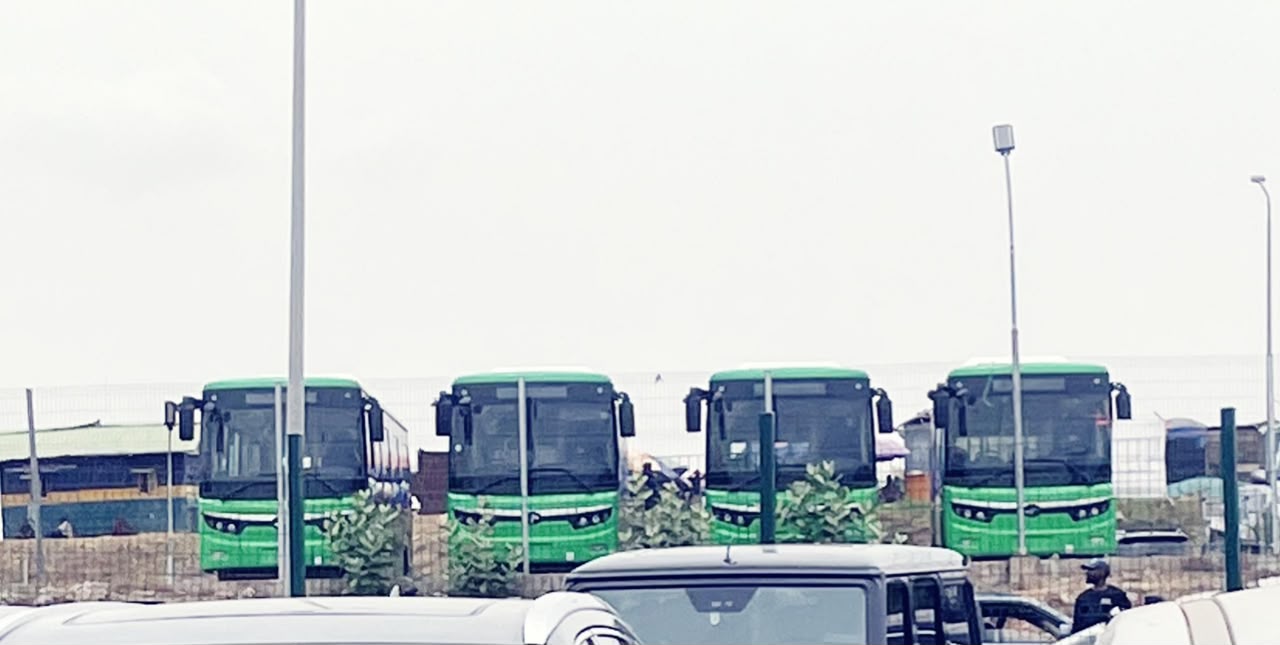
A green, silent bus waited at the park outside the domestic arrival terminal of Nnamdi Azikiwe International Airport. Its doors were open, but the seats were mostly empty.
Nearby, taxi drivers called out for passengers. Travelers pushed their luggage past without looking twice. Some were heading to car hire services, others to their personal cars or family, while one passenger moved towards the green shuttle bus.
Inside the bus, Anita Mathew sat waiting.
"Well, I am using the bus for the first time to try it out. They told me about it at the exit door, so I said let me try it," she said, glancing at the bus door now and then.
But even as she settled in, she was not sure if she would come back.
"From the airport to the city, it is cheaper, but it is not going to take me to my final destination. When I get there and calculate everything I spent, then I will know."
Her uncertainty shows a bigger issue. Months after starting, Abuja's electric airport shuttle buses still struggle to attract passengers.
The electric shuttle service began on January 30th, launched by the Federal Airports Authority of Nigeria (FAAN). This move aims to cut carbon emissions and reduce the use of fossil fuels at the airport.
At the launch, FAAN said the project fits with its renewable energy plan. This plan also includes solar lighting, energy-efficient upgrades, and waste reduction across airports.
The project partners with Possible Electric Vehicles (Possible EVS), which introduced zero-emission buses to transport passengers between the airport and the city.
FAAN’s Board Chairman, Abdullahi Ganduje, and Managing Director, Olubunmi Kuku, called the initiative part of efforts to modernize airport facilities and promote cleaner energy use.
Even though the service operates at the airport, FAAN's Head of Commercial, Matawal Solomon Moses, told PREMIUM TIMES that the buses are not owned by FAAN.
"They are not owned by FAAN. It is owned by a private investor, Possible Electric Vehicles (Possible EVS). FAAN only granted them the opportunity to operate and do business at the airport, just like other car hire services, so it is strictly business."
He mentioned that the company has assigned 10 buses to the airport, which are currently in use. Under this agreement, the company operates the service between the airport and its terminal in Wuse 2.
"They pick passengers from the airport and go straight to their business park, unlike car hire services that take you to your doorstep," he added.
Passengers can book their rides online or simply board at the airport, where staff promote the service at the arrival exit.
Outside the airport, Possible EVS is a Nigerian electric mobility company focused on creating clean transport systems.
The company gets its electric buses from NEV Electric Company, which assembles them locally in Nigeria.
Abimbola Oduwole Gyer, Head of Operations at Possible EVS, said, "Our goal is to change the way Nigerians see commercial transport. We want to make mass transportation green and reduce carbon emissions."
She explained that the company finances and puts electric vehicles in use to promote cleaner options to fuel-powered transport. Industry reports place Possible EVS within Nigeria’s growing electric mobility sector focused on electric buses, taxis, and charging stations.
The buses operate on a fixed schedule. From the airport, they leave every hour between 8 a.m. and 6 p.m., whether full or not. From Wuse 2 to the airport, they run from 7 a.m. to 7 p.m.
Each bus waits a maximum of 30 minutes before leaving.
"We move even if passengers are less than five. Even if it is one or two passengers, as long as they enter the bus, we will carry them," said driver John Machunga, one of the green bus drivers.
Currently, the service runs only between the airport and Wuse 2, with three stops: Bovas Filling Station, Lugbe, and Federal Secretariat.
From Wuse 2, passengers can connect to electric taxis for the rest of their journey. The trip takes about 45 minutes to the city center. But the usage is low and changes day by day.
"There are days we move 80 passengers total, some days 50, sometimes 90, but per bus, we carry an average of about five to six passengers. We also carry even less than that, as long as a passenger enters even if it is one, we can’t tell them to drop. We will still carry them to the city," Mr Machunga said.
He estimated daily usage at about 10 to 15 percent of airport passengers.
"It is just barely three months old. We are still creating awareness," he told PREMIUM TIMES in April. When this newspaper checked back in June, things had not changed much.
Ms Oduwole Gyer agreed, adding that occupancy averages about five passengers or fewer per trip. She said while exact numbers are not officially counted, about 45 percent of users come from Lagos.
"Most passengers say they didn’t know about it when they arrive," she added.
The buses charge a flat fare of ₦10,000, much lower than the ₦25,000 to ₦30,000 typically charged by airport taxis.
"The main purpose is to cushion the high price of airport taxi and ensure clean air. It is 100 percent electric. Zero emission," Mr Machunga said.
But being cheaper has not led to more people using it.
"You will have to wait. And when you get to the city, you will still take another transport," Ms Mathew said.

That extra part, along with waiting time before leaving, is a big worry for many travelers. Another passenger, Halima Abdul-Salam, who travels often, said she always sees the bus from the terminal and knows about it but has never used it. For her, the waiting time is a problem.
"I always have appointments. I don’t want to waste time; that is a problem for me."
Others said they did not know about the service at all.
"This is my first time hearing about it," said Samuel Daniel.
Explaining the route choice, Ms Oduwole Gyer said Wuse 2 serves as a central hub.
"It is the city center where we can move more people and they can easily find their way from there. So the company chose Wuse 2 instead of other places," she said.
She added that they are planning to expand.
"We just started, and we are considering customer feedback to determine our next steps."
FAAN’s head of commercial, Mr Moses, also agreed.
"We are open to expansion and improvement based on passengers’ needs. That is paramount to us," he noted.
For some passengers, the service offers comfort and safety. Mowa Adikpe said he chose the bus after trying it for the first time.
"I saw the bus and liked it because you can sit comfortably. It is cheaper than direct taxi, and I don’t mind waiting as long as it is safe and comfortable for me. So I will use it again if I have the chance to."
He also shared safety concerns.
"I once used a taxi, and the driver ran away with my luggage. So this bus is safer for me."
But he acknowledged its limits.
"It will take me to the city center, then I will take another taxi," he said.
Another passenger, Richard Obi, said he likes the service but wants it to cover more areas.
"I like it. But I hope it goes everywhere in town. It should not just stop at Wuse 2. It should drop passengers at any location."
To check claims around comfort and efficiency, this reporter took a ride on one of the electric buses from the airport to Wuse 2 with two other passengers. After waiting for 30 minutes, the bus started moving. The ride was quiet and smooth, much different from regular fuel-powered vehicles. The bus moved steadily through traffic with little vibration, offering a calm journey compared to the often hurried pace of airport taxis.
The trip also gave a clear view of Abuja’s landscape, making it feel relaxed, almost like a sightseeing trip. But the fixed route ended at Wuse 2, which means passengers heading to other parts of the city need to find another way, a limit many users mentioned.
Operators say visibility is still a big issue.
"Some customers say they didn’t know about the electric buses. We are working with FAAN to help create awareness inside the airport," said Ms Oduwole Gyer.
She added that limited access inside the terminal makes it hard to engage with passengers.
"We don’t have office space inside the airport. That also limits attraction."
Electricity supply is another problem.
"Sometimes we want to charge our buses, but there is no light, and the buses depend on electricity 100 percent. We don’t have an alternative yet," she said sadly.
Each bus has a battery capacity of about 200 kilometers and operates entirely on fast-charging systems. For traditional taxi and ride-hailing drivers, the service is not a threat yet.
"This is business, and it is not affecting us in any way. Besides, we are many here, and they only have a few buses," said Suleiman Umar, a car hire driver at the airport.
A Bolt driver, Sunday Emmanuel, agreed but pointed out price differences.
"It is still business as usual. People use Bolt because they want direct rides."
He added that even though the buses are cheaper, convenience still matters more to most passengers.
"Our prices may be higher, but we take passengers straight to their destination without waiting or stopovers," he said.
Drivers think they still carry about 80 percent of passengers. While passengers complain about the waiting time and double trips, FAAN insists this initiative is part of a larger move to cleaner energy.
"Electric vehicles help reduce carbon emissions," Mr Moses said.
But usage is low, with operators estimating that only a small number of passengers currently use the service daily. Back at the terminal, the green bus filled slowly, leaving with only four passengers for Wuse 2, a 20-seater bus that usually carries 16 passengers, with the last four seats reserved for luggage.
Despite mixed feelings, a clear pattern shows. Passengers want wider routes, faster departures, and direct drop-offs across Abuja, not just set stops in Wuse 2. For many, the hope for cheaper, cleaner transport is appealing, but only if it matches the ease, speed, and flexibility of taxis and ride-hailing services they already use.



Comments
No comments yet.