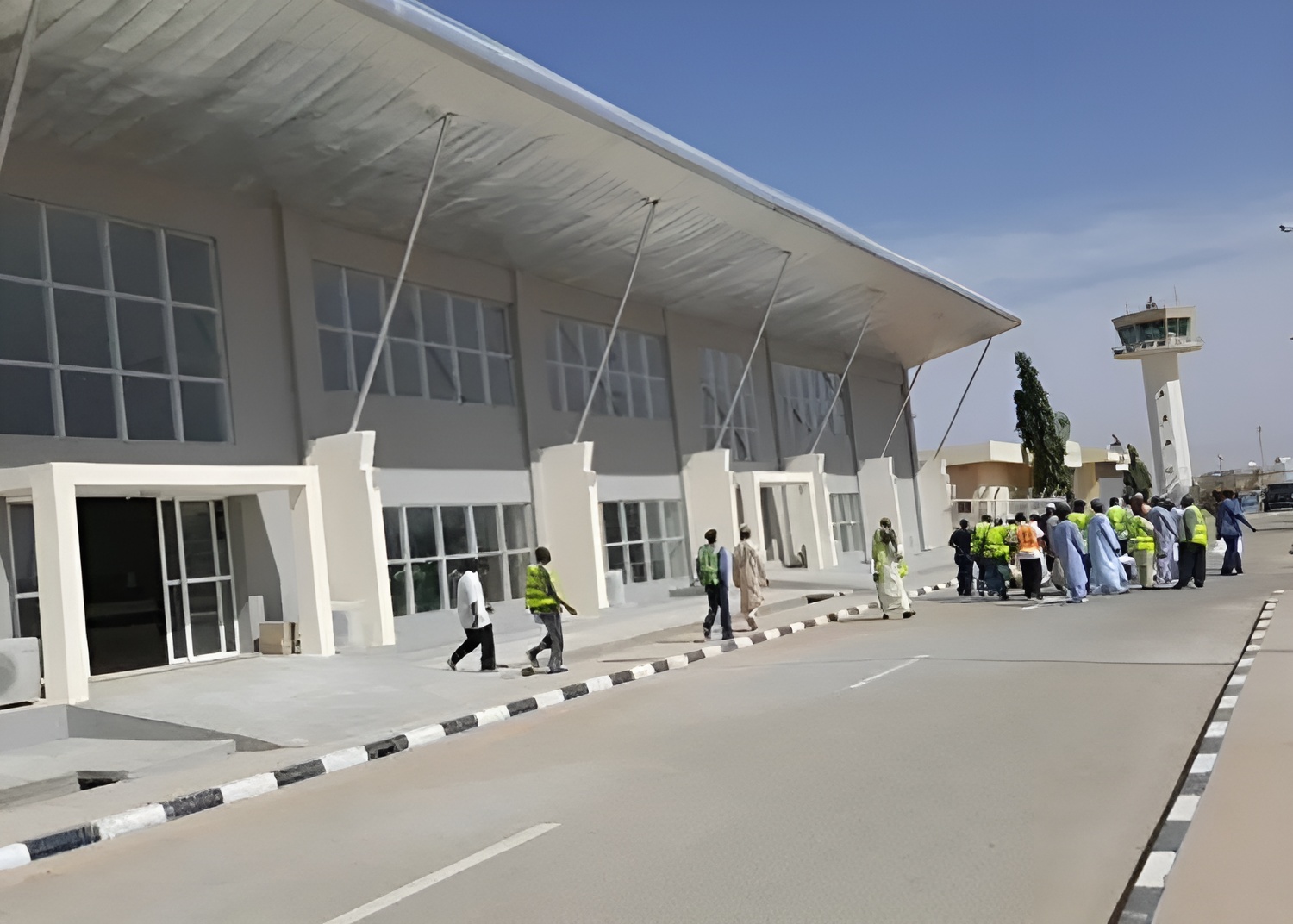
The mood at the Umaru Musa Yar’Adua International Airport in Katsina was festive. Families eagerly waited to welcome loved ones back from Saudi Arabia after finishing the 2026 Hajj pilgrimage. Airport officials carried on with their usual routines, and returning pilgrims pushed their luggage toward the main arrival area after showing their travel documents for border checks.
Suddenly, without warning, things changed.
As passengers lined up for immigration checks, border officers quietly singled out seven men from the crowd. There was no chaos, no shouting, and no dramatic scenes in the terminal. The men were discreetly taken aside from the other pilgrims, escorted away under tight security, and placed in custody.
Within hours, the seven detainees were moved from the airport under armed escort and flown to Abuja, where they were handed over to the State Security Service (SSS).
Days later, the Minister of Interior, Olubunmi Tunji-Ojo, made a public statement that sparked a national conversation. He said that security agencies had intercepted seven suspected commanders of Boko Haram and ISWAP returning from the Hajj through Katsina airport.
Nigeria grapples with various forms of terrorism from groups like ISWAP, Boko Haram, and armed bandits. Many bandit groups are active in Katsina, where countless people have lost their lives or been kidnapped in recent years.
The government touted the arrests as proof of Nigeria’s improving border management, showcasing advancements in biometric identity checks and real-time intelligence sharing among security agencies.
As of the time of writing, neither the federal government nor the SSS disclosed the identities of the seven suspects or any criminal charges against them.
While the minister’s announcement made headlines nationwide, it also left many questions unanswered. The most pressing question is not how the men were caught upon their return, but how they managed to leave Nigeria in the first place.
Unlike some criminals who use fake travel documents or stolen identities, immigration officials told PREMIUM TIMES that the seven suspects traveled with valid Nigerian international passports issued in their real names.
These seven men completed all necessary Hajj travel procedures before departing Nigeria. This situation raises serious questions about accountability that go beyond just the fate of the suspects: What security checks are in place before a pilgrim is allowed to leave Nigeria? Which agencies are responsible for identifying applicants on national security watchlists? Did intelligence about these suspects come to light only while they were abroad, or were opportunities to stop them missed before they flew out? Most importantly, where does accountability lie among the many state and federal agencies that manage one of Nigeria’s largest annual international migrations?
Over several days, PREMIUM TIMES spoke with security personnel familiar with the airport operations, talked to anonymous policy and intelligence sources, and reached out to civil society leaders. We visited the Katsina State Pilgrims Welfare Board headquarters. We also reviewed government statements and looked into the processes involved in the annual Hajj.
The findings revealed a disjointed picture. Federal authorities described the operation as a success due to intelligence-led border control, while civil society groups claimed it highlighted gaps in pre-departure checks. Many institutions responsible for processing pilgrims either declined to explain their screening methods or did not answer key questions.
Instead of determining the suspects’ guilt or innocence, this investigation looks at how these institutional responsibilities connect and where accountability for pre-departure checks lies.
Understanding the Hajj Vetting and Registration Process
To understand how the seven suspects left the country, we must look at the structured process a regular citizen follows to go for Hajj under Nigeria’s official guidelines.
Going for Hajj is not just a simple trip; for most Nigerian Muslims, it involves a lengthy, regulated process that includes many responsibilities across state governments, federal agencies, and Saudi authorities.
The entire process starts at the grassroots level with state agencies like the Katsina State Pilgrims Welfare Board. Hajj officials receive applications and help pilgrims register. After discussions with Saudi authorities, the National Hajj Commission of Nigeria (NAHCON) announces the official Hajj fare, which includes airfare, accommodation, meals, local transport, and other logistics.
Potential pilgrims must pay this fare, which has increased significantly to between seven and eight million Naira due to inflation and exchange rates, directly into the state board’s designated bank accounts.
Once the financial obligations are met, the applicant moves on to the documentation stage. Interviews with Hajj stakeholders and border officials indicate that the international passport is now the main identity document for the registration process. Unlike in the past, when many documents were needed, most personal information, including biometric data and National Identification Numbers (NIN), is now embedded in the passport following enrollment by the Nigeria Immigration Service (NIS).
After local documentation is done, the state board compiles the names of qualified applicants from different local government areas into a single register. This list goes to NAHCON headquarters in Abuja for national coordination.
NAHCON uploads the pilgrims’ data into Saudi Arabia’s electronic Hajj portal, where the Saudi Ministry of Hajj and Umrah issues mandatory entry visas electronically. Only after the electronic visas are approved are the pilgrims assigned to outbound flights, and final passenger lists are created for each state group, showing who is cleared to board.
According to immigration officials who spoke to PREMIUM TIMES anonymously, the NIS’s responsibilities change significantly from issuing passports to clearing passengers for departure. The main job of officers at the international departure terminals is to enforce immigration laws, verify identity, and check travel documents.
As a result, immigration officers mainly check identity and travel documents and depend on intelligence alerts or watchlists provided through the national security system to decide if a traveler should be stopped.
An immigration officer in the area explained that their main role at the departure gate is to clear passengers. The source said that when travelers show their passports, biometric checks are conducted to ensure the passport is genuine and that the person is the legitimate holder of it.
The official stressed that routine immigration checks focus on identity, while tracking terrorism suspects is the job of specialized intelligence agencies.
Federal pilgrimage authorities clarified this division of responsibilities. When contacted by PREMIUM TIMES, NAHCON spokesperson Fatima Usara stated that NAHCON does not conduct background checks or profile travelers.
Mrs Usara explained that NAHCON does not handle screening operations, stating those tasks fall to state units. According to her, state boards are in charge of organizing and managing pilgrim manifests, while NAHCON sets standards and monitors implementation.
Regarding national security protocols, Mrs Usara added that while NAHCON works with security agencies, the main responsibility for passenger lists lies with state operations.
This situation shows a critical divide in operations. While airport immigration personnel check identity at the point of travel and federal regulators monitor compliance with standards, the active vetting of individual backgrounds is the responsibility of the state-level bodies that create the lists. Many states, however, do not have the resources for such checks since Nigeria’s security agencies are mainly controlled by the federal government.
To find out how the seven suspects passed through these early stages, PREMIUM TIMES visited the Katsina headquarters of the State Pilgrims Welfare Board to learn about the safeguards and checks in place for the pilgrim recruitment process. The board refused to provide details.
During the visit, the Executive Director of the Katsina State Pilgrims Welfare Board, Yunusa Dankama, declined to discuss the registration process or explain how they cross-reference applicant lists with national security watchlists.
He stated that details about the processing of the state’s Hajj delegation are classified and cannot be shared with the public or the press, insisting that such operational transparency is only for registered pilgrims. He added that the Katsina State Pilgrims Welfare Board is only a logistical and administrative body, not a security agency.
This refusal to share information leaves a gap in the public’s knowledge of the administrative processes. While airport security staff explained their exit responsibilities, the state agency responsible for processing applicants and managing the final flight lists did not clarify how its checks work before pilgrims reach the airport.
One question investigators may still need to answer is whether any local documentation played a part in the application process for individuals later labeled as security suspects.
The Outbound Journey: Why the suspects weren't stopped at departure
The operation that led to the isolation of the seven suspects at the airport happened in just minutes during standard arrival checks. However, a more important question is why the same security system that caught the men when they returned allowed them to board their outbound flight weeks earlier.
PREMIUM TIMES sought to clarify this timeline by talking to border officials and those involved in policy-making.
An immigration officer familiar with the airport operation, who wanted to remain anonymous, explained that the suspects were not stopped when they left because the active intelligence process from Abuja had not reached the stage where a physical interception could be authorized.
The source said that the investigation was still ongoing during their outbound journey, but before their return flight landed, the intelligence process had advanced, and a directive was sent from Abuja to apprehend the specific passengers as soon as they arrived.
This was confirmed by a senior official at the NIS Headquarters in Abuja, who shared details off the record.
The official revealed that the suspects’ profiles had been processed and placed on a watchlist by the NIS Integrated Operations Centre in Abuja before their return. The source indicated that allowing watchlisted individuals to leave can sometimes be a tactical strategy, enabling intelligence agencies to gather evidence or monitor networks while relying on the pilgrimage’s logistics. Typically, pilgrims return through the same airport they left from.
The source added that the border management system was fully prepared for their arrival, with their names and biometric profiles sent to the Katsina Airport Command well before the plane entered Nigerian airspace. The moment the suspects presented their passports at arrival desks, the system triggered an alert, allowing officials to quietly isolate them without disrupting the clearance of the rest of the passengers.
All officials contacted confirmed that the seven suspects traveled on valid passports issued under their real names.
However, allowing suspected terrorists to travel for Hajj only to arrest them upon their return is risky. The suspects could have been arrested by Saudi authorities, who have previously detained and deported Nigerian pilgrims despite having clearance from Nigerian authorities. Such an arrest by Saudi officials would have embarrassed Nigeria. Worse, the suspects could have committed acts of terror in Saudi Arabia, damaging Nigeria’s reputation. PREMIUM TIMES tried to ask the SSS about these issues, but the agency refused to comment.
While the explanations from officials provide an operational view of the timing of the arrests, they do not answer the larger question. When did the seven suspects first come to the attention of federal intelligence agencies? Was there information connecting them to insurgent activity available before they joined the Katsina State Hajj group, or did it appear only after they left the country?
Local Accountability: Questions and Responses from Authorities
The silence surrounding the pre-departure vetting process has sparked a heated public debate in Katsina State about how individuals later labeled as security suspects could pass through local registration channels. After the Minister of Interior’s announcement, several regional commentators and critics raised questions about the suspects’ funding and documents.
Bashir Kurfi, a local social critic, questioned whether the men stopped at the airport had received state-funded Hajj, possibly as part of local political amnesty programs aimed at encouraging armed groups to disarm.
In a statement to the press, the Katsina State Ministry of Internal Security and Home Affairs called the allegations unfounded and false. The Commissioner for Internal Security and Home Affairs, Nasir Mu’azu, claimed the accusations were politically motivated to undermine the state’s security efforts. The ministry warned that the state government would take legal action against anyone spreading false information.
PREMIUM TIMES found no evidence from government statements or from officials interviewed that the seven detainees received state-sponsored Hajj. Hajj pilgrims in Nigeria typically fall into three categories: those who pay for themselves, those funded by wealthy individuals, and those supported by the state.
Beyond funding questions, local civil society organizations argue that this incident raises concerns about whether current administrative safeguards are enough to protect the grassroots level of pilgrimage administration. Abdulrahman Abdullahi, chairman of the Coalition of Civil Society Organizations in Katsina State, stressed that the lengthy process of Hajj logistics makes the absence of pre-departure checks a significant worry.
"An international pilgrimage is not a last-minute trip where someone just walks into a bus station and boards a vehicle," Mr Abdulrahman told PREMIUM TIMES. "The fare processing, passport enrollment, local documentation, and required orientation take weeks or months. If individuals later identified as security suspects completed all these steps before traveling, we need to understand what went wrong during that time. Security measures must be proactive, not reactive."
A similar critique was made by Jamilu Charanchi, the national coordinator of the Coalition of Northern Groups (CNG). Mr Charanchi argued that this incident highlights the need for a thorough review of the screening process for official pilgrimages.
"If people suspected of serious terrorism can use our official pilgrimage routes to leave and return without being stopped, then the screening system needs a deep examination," Mr Charanchi told PREMIUM TIMES. "The federal government, state authorities, and security leadership must set up an independent committee with security agencies and relevant Hajj authorities to pinpoint gaps in the screening process and improve future pilgrim checks."
Previous Security Arrests Linked to Pilgrimage
The Katsina operation is not the first time Nigerian security agencies have arrested important security suspects linked to religious pilgrimage.
In May 2025, SSS operatives arrested two wanted kidnappers during Hajj screening. They were Yahaya Yakubu at the Abuja Hajj camp and Sani Galadi, also known as Mai Boxer, at the Sokoto Hajj camp before they could travel to Saudi Arabia.
Earlier, in September 2022, Tukur Mamu, who later faced terrorism charges, was caught in Cairo while going for Umrah and sent back to Nigeria in DSS custody.
The Katsina case is different because the suspects were caught after completing the Hajj and returning to Nigeria. The federal government also presented their arrest as proof of Nigeria’s effective biometric border management system.
Transparency and Accountability: Seeking Responses
To ensure fairness and give every relevant institution a chance to respond to this investigation, PREMIUM TIMES sought clarification from all key organizations involved in the Hajj and security processes.
The SSS was contacted to clarify if the suspects were under investigation or surveillance before leaving Nigeria, when they were put on the watchlist, whether they have been charged, and if investigations are ongoing. As of the time of writing, the agency’s spokesperson has not responded to our inquiries.
NAHCON, through its spokesperson, Mrs Usara, stated that it functions strictly as an administrative manager and regulator. She noted that it does not conduct background checks or manage passenger manifests, as these tasks are handled by state-level boards.
After repeated inquiries by PREMIUM TIMES, the Public Relations Officer of the Nigeria Immigration Service, Akinsola Akinlabi, confirmed that the Service arrested the suspects and handed them over to the requesting agency. However, he declined to comment on operational details, including pre-departure checks and the ongoing investigation, citing the sensitivity of the matter.
Meanwhile, this reporter visited the Katsina State Pilgrims Welfare Board to inquire about local documentation safeguards and the verification of registries from local government areas. The executive director stated that the board is just an administrative body and not a security agency.
Finally, the Katsina State Government, through the Ministry of Internal Security and Home Affairs, issued a statement denying any state sponsorship or funding for the suspects’ travel, calling all such rumors politically motivated falsehoods lacking evidence.
Final Thoughts
As the seven suspects remain in federal custody and investigations continue, the key questions from the Katsina operation remain unanswered. The arrests showed that Nigeria’s border security system can spot watchlisted travelers upon arrival.
What is still unclear is whether the bodies responsible for processing pilgrims had access to information that could have stopped the journey in the first place. Until these questions are addressed, this case will challenge not only Nigeria’s fight against terrorism but also the accountability of the agencies that manage the country’s largest annual international migration.



Drop your comment
No comments yet — be the first to drop the gist 👇