Court Allows Aondoakaa to Run for Benue Governor
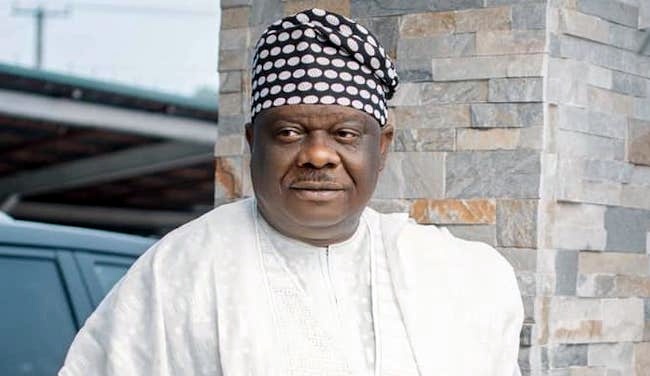
The Federal High Court in Abuja has dismissed a case aimed at preventing Michael Aondoakaa from running for governor of Benue State in 2027. The court ruled the case was filed too late.
The Federal High Court in Abuja has thrown out a case brought by four people from Benue State. They wanted to stop former Attorney-General of the Federation, Michael Aondoakaa, from running for the 2027 governorship election in the state.
On Monday, Justice Joyce Abdulmalik said the plaintiffs did not have the legal right to file the case. She supported the objections raised by the defendants, stating that the case was not valid and was really a pre-election issue disguised as a way to enforce an earlier decision.
The judge pointed out that the case was brought too late, beyond the 14-day limit set by law. She also dismissed the plaintiffs' claim that they only became aware of Aondoakaa’s nomination by the Peoples Democratic Party (PDP) on August 30.
"The evidence before the court clearly showed that the third defendant was declared the winner on June 24, 2026, and presented with a certificate of return on June 26, 2026.
This suit, having been filed outside the mandatory 14 days, is statute-barred and is dismissed in its entirety," the judge said.
The Nigerian Tribune reported the judgement on Monday. The court also said the plaintiffs did not prove why they should get what they asked for.
The plaintiffs, David Ejembi, Aondoaver Teryila, Joseph Okpanachi, and Benedict Orkume, filed the case marked FHC/ABJ/CS/2152/2026. They named the Independent National Electoral Commission (INEC), the PDP, and Aondoakaa as defendants.
They relied on a Supreme Court ruling in Michael Kaase Aondoakaa v. Obot (2022) 5 NWLR (Pt. 1824) 523. They argued that this ruling stopped Aondoakaa from holding any public office.
They wanted the court to say that INEC must follow the Supreme Court ruling by not allowing the PDP to support Aondoakaa for the 2027 governorship election. They also wanted an order for the PDP to withdraw his nomination and an injunction to stop INEC from accepting his nomination and Aondoakaa from running.
The plaintiffs said that sections 235 and 287(1) of the Constitution, alongside the definition of a public office in section 318(1), required INEC and the PDP to follow the Supreme Court's ruling.
But Justice Abdulmalik said the plaintiffs, who called themselves registered voters in Benue, could not prove they had the right to bring this case as a public interest issue. She added that the case was really a pre-election matter.
Since the plaintiffs were not candidates in the PDP governorship primary, they did not have the right to challenge its outcome. The judge also said they were not part of the earlier case they wanted to enforce and had not shown enough evidence to support their demands.
Aondoakaa's legal team, led by Anthony Ijohor, a Senior Advocate of Nigeria (SAN), asked the court to dismiss the case as weak. The defence challenged the plaintiffs' counter-affidavit, saying that parts of it were based on hearsay. The defence maintained that the plaintiffs could not use a new case to enforce a final decision in a case where they were not involved.
The defence also argued that only someone with a judgement could seek to enforce it against a debtor. They referred to past court rulings, including AMCON v. Capital Oil & Gas (2019), to support their argument.
They further claimed that the suit was too early because the 2027 election had not taken place. They said the plaintiffs had not shown any special interest or harm from Aondoakaa's candidacy. The defence said the reasons for disqualification from an election are in section 182 of the Constitution and the plaintiffs could not force INEC to stop the PDP from sponsoring a candidate based on their claims.
This case came from a Supreme Court ruling that confirmed Aondoakaa’s disqualification from holding public office because of his actions while serving as Attorney-General of the Federation. The issue started from the 2007 PDP primary election for the Uyo Federal Constituency in Akwa Ibom State, which Emmanuel Obot won.
Obot challenged the replacement of his name with another candidate. After court cases, the Court of Appeal ordered a new election tribunal to hear his petition. However, Aondoakaa, who was AGF at the time, wrote to the President of the Court of Appeal, asking him not to follow the appellate court’s order.
When the tribunal ruled in Obot’s favour in April 2008, the Court of Appeal backed that decision in December 2009, ordering INEC to issue Obot a certificate of return. Aondoakaa later wrote to the then INEC chairman and the Speaker of the House of Representatives, telling them not to follow the judgement.
Obot filed a separate case questioning Aondoakaa’s ability to hold public office. On June 1, 2010, the Federal High Court ruled that Aondoakaa was not fit for public office and awarded Obot ₦50 million in damages. The Court of Appeal rejected Aondoakaa’s appeal on September 3, 2015, supporting the earlier court's decision.
On December 10, 2021, the Supreme Court also dismissed his appeal, agreeing with the lower courts' decisions. The apex court criticized Aondoakaa’s actions while he was the country’s chief law officer, saying he acted in an unprofessional manner.
The latest ruling dismisses the case brought by the four residents. The court's decision was based on the plaintiffs' lack of legal standing and the procedural issues found in the case.
Comments
No comments yet.