Funding Cuts and Inaction Threaten Lives of HIV Patients in Rivers and Akwa Ibom
Funding cuts have left HIV patients like Grace without essential support. An investigation reveals that state governments are not stepping up as donor aid decreases.
Grace* has never seen a state budget document. She has not read a federal appropriation law or looked at a budget report.
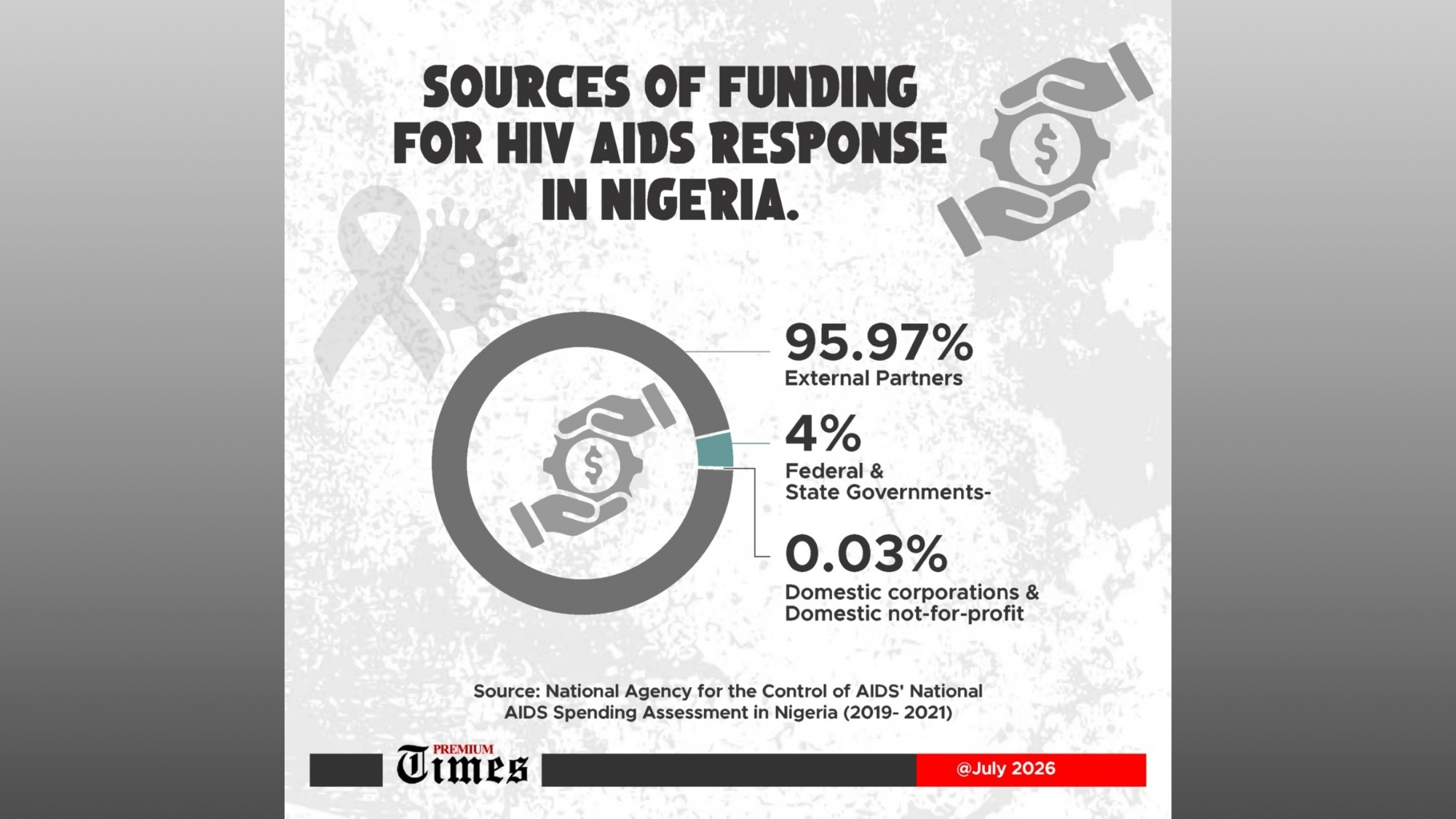
She likely does not know that international donors largely fund Nigeria's HIV response. For years, both federal and state governments promised to take more responsibility for programs that keep people alive, like her.
What she does know is this: the community health worker who used to bring her antiretroviral medicines has stopped coming. The counselling sessions ended, and the support that helped her manage stigma disappeared.
Now, Grace has to go to a public treatment center to collect her medication. There, she feels exposed and recognized, which made her withdraw from care.
Her story raises an important question. As international donors cut back on community HIV programs, were the governments in Rivers and Akwa Ibom, two states with high HIV rates, ready to step in?
An investigation by PREMIUM TIMES, using official budgets, implementation reports, and interviews with officials and health advocates, found little evidence they were.
Instead, the investigation revealed a troubling pattern regarding responsibility and accountability.
Year after year, both state and federal governments approved budgets for HIV programs. Yet, much of this money was never released.
This has weakened health systems, interrupted community services, and led to patients disappearing from care without anyone noticing.
As donor support decreased, everyone expected the governments to take over. But PREMIUM TIMES found no proof this happened in Rivers and Akwa Ibom. The states kept making budget provisions for HIV response while implementation lagged.
Budgets Approved, Funds Withheld
Official documents and reports from PREMIUM TIMES show a repeating pattern in Akwa Ibom and Rivers states. They budgeted for HIV programs but often failed to release the funds.
In Akwa Ibom, the State Agency for the Control of AIDS received capital allocations in every budget cycle reviewed. In 2023, they were allocated N24.05 million, N10 million in 2024, N33 million in 2025, and N150 million in 2026.
These funds were supposed to cover essential HIV response activities, like buying antiretroviral medicines, test kits, condoms, and screening supplies.
On paper, these commitments look good. But the approved funds were less than one percent of the total health sector budget each fiscal year.
Reports show that despite these allocations, the agency received no capital releases between 2023 and 2024.
The state has not published the budget implementation report for 2025 or the first half of 2026. This makes it hard for the public to see if any money was released or how it was spent.
When contacted, Health Commissioner Ekem Emmanuel said the agency received some support towards the end of 2025. However, neither he nor the State Agency for the Control of AIDS provided proof of the amount released or the programs funded.
The National Agency for the Control of AIDS (NACA) told PREMIUM TIMES that Akwa Ibom only released one percent of its total HIV appropriations for 2024 and 2025. This suggests that the state spent no more than N330,000 out of its N33 million capital budget.
In Rivers State, PREMIUM TIMES found a similar situation. The state allocated N180 million for HIV interventions in 2023 and N230.66 million in 2024.
These funds were meant for test kits, community counseling, condom distribution, and even creating an anti-stigma law. Yet, the budget reports show that none of these funds were released.
For 2025 and 2026, Rivers State has not published the necessary documents to review HIV spending. PREMIUM TIMES did not get any clarification from the State Agency for the Control of AIDS.
NACA stated that Rivers State had zero releases for HIV/AIDS during the review period.
These findings show that while both states continued to budget for HIV response, they did not release the funds. This was at a time when international support was uncertain.
Accountability Beyond the Budget Books
The implications of this go beyond just accounting records. Every unreleased allocation means programs could not run, outreach campaigns did not happen, and patients were not followed up on after they missed appointments.
Uduak Nyaetok, the executive director of Milestone Initiative for Human Rights and Empowerment, an NGO in the Niger Delta, told PREMIUM TIMES that HIV treatment does not start with antiretroviral medicines. It begins with prevention, especially finding those who do not know they are infected.
She said, "After testing, a good HIV response depends on counsellors who encourage frightened patients to start treatment. It relies on community workers who go back to homes after missed appointments and support groups that help people overcome stigma."
According to Ms Nyaetok, the withdrawal of donor-funded services disrupted this care chain. She noted that while some activities have resumed since June, the interruption showed the consequences of the government not taking greater ownership of the HIV response.
“When the support was withdrawn, those who followed up on treatment were no longer there. The viral suppression of patients dropped. When they engage in risky behavior, infections will definitely rise,” she added.
NACA agrees with her. They told PREMIUM TIMES that program data shows setbacks in coverage for case finding, pre-exposure prophylaxis uptake, and condom distribution due to reduced community-level interventions funded by the U.S. government.
Ms Nyaetok stressed that state governments need to invest more in community-based HIV services, especially in rural areas where many people live far from health facilities.
For people like Grace*, losing community-based support was not just about losing a donor-funded program. It meant losing the very services that helped them stay in treatment, protect their privacy, and live with dignity.
Federal Spending Tells Similar Story
The issue of accountability is not just with state governments. A PREMIUM TIMES review of federal financing from 2021 to 2026 shows a growing gap between budget approvals and actual spending.
In 2025, with uncertainty over international HIV funding, the federal government approved N18.27 billion for NACA as capital expenditure. This was more than double what was approved in 2024.
The increase suggested a recognition that domestic financing needed to grow as donor support became less reliable. Yet, records showed that only 31.2 percent of the approved capital allocation was funded.
The following year, domestic investment fell even more. The 2026 budget approved N13.97 billion for NACA, but only N36.68 million (0.3 percent) was spent from January to May.
NACA informed PREMIUM TIMES that capital release improved by June, with the agency receiving 3.8 percent of the approved amount mid-year.
Worse still, only N16.13 million of that went towards HIV response programs, and only in Lagos State.
By June, NACA said total HIV response expenditure in Lagos rose to N210 million. However, they clarified that this covered two different constituency projects.
The remaining funds went to cleaning services and staff welfare. For example, N7.4 million was for cleaning services, while N13.12 million was spent on food supplies for staff.
These figures raise serious questions about Nigeria’s ability to maintain HIV services as international partners reduce direct support.
This disconnect threatens the global goal of controlling HIV. The UNAIDS 95-95-95 targets aim for 95 percent of people with HIV to know their status, 95 percent of those diagnosed to receive treatment, and 95 percent of those in treatment to achieve viral suppression. But meeting these targets requires more than just buying medicines.
“It demands ongoing investment in community testing, patient follow-up, counselling, and community support,” Ms Nyaetok said.
She added that these investments have been declining just when governments were expected to take charge of the response.
As the goal of ending AIDS as a public health threat by 2030 draws near, NACA insists Nigeria is well-positioned to meet these targets. But they warn that funding instability from both government and donors poses a significant risk.
Editor’s Note: The names marked with asterisks have been changed to protect the privacy and identities of vulnerable individuals featured in this report.
Get more stories like this on your home page
How this story developed
Funding Cuts and Inaction Threaten Lives of HIV Patients in Rivers and Akwa Ibom (this story)
- Funding Cuts and Government Inaction Threaten Lives of HIV Patients in Rivers and Akwa Ibom
- Funding Cuts and Lack of Action Affect HIV Patients in Rivers and Akwa Ibom



Comments
No comments yet.