Government Reports 60% Drop in Maternal Deaths in Health Facilities
The Nigerian government has reported a significant 60% drop in maternal deaths in health facilities supported by the BHCPF, exceeding its target.
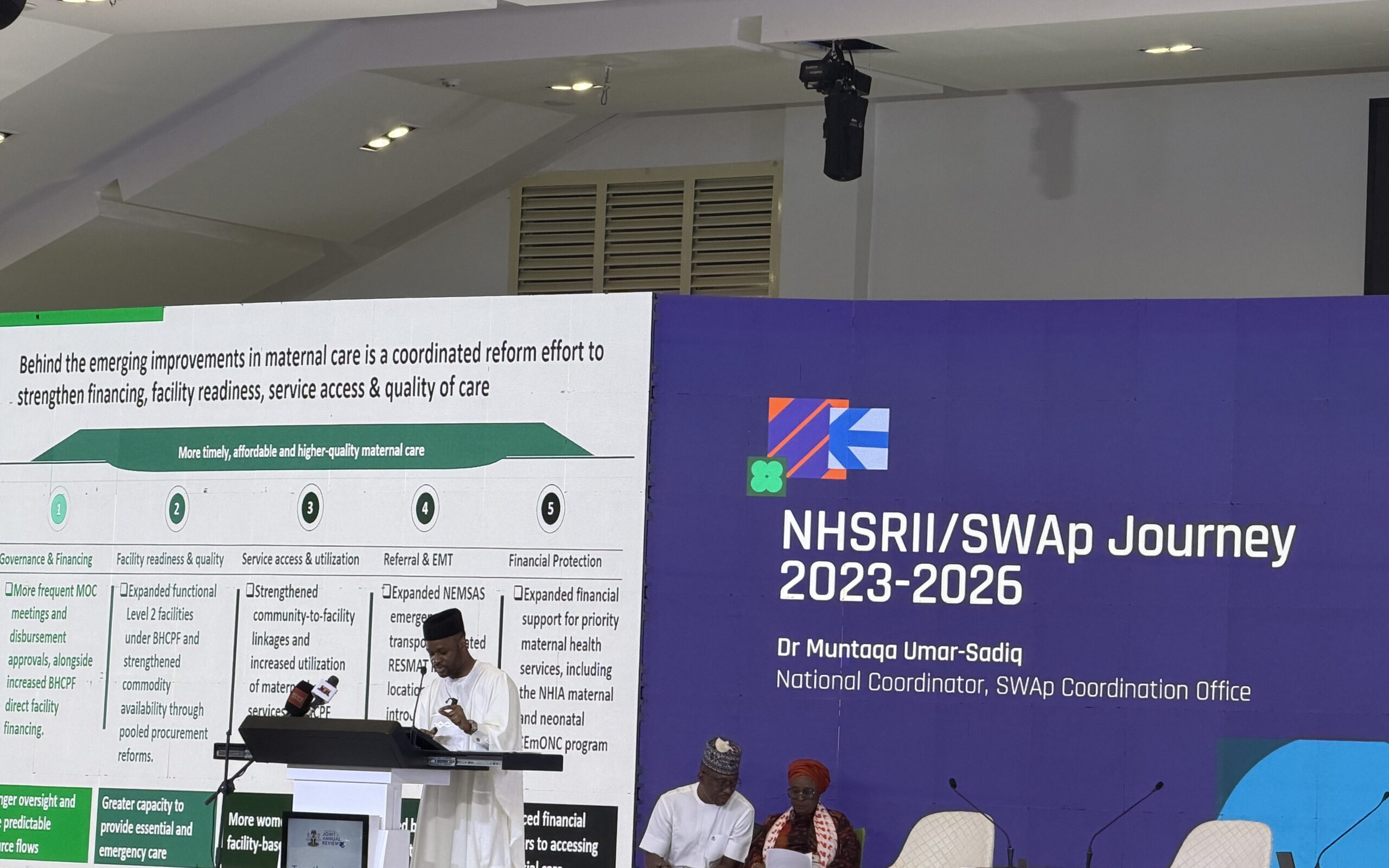
The Nigerian government has announced a 60 percent drop in the maternal case fatality rate in health facilities supported by the Basic Health Care Provision Fund (BHCPF) from 2024 to September 2026.
The rate fell from 80.5 in 2024 to 31.9 in September 2026, surpassing the government’s goal of reducing maternal deaths in these facilities by 30 percent.
Muntaqa Umar-Sadiq, the National Coordinator of the Sector-Wide Approach (SWAp) Coordination Office, shared this news on Tuesday during the 2026 Nigeria Health Sector-Wide Joint Annual Review (JAR) in Abuja.
While presenting the progress report on the National Health Sector Renewal Investment Initiative (NHSRII), Mr Umar-Sadiq said these improvements resulted from reforms aimed at enhancing healthcare financing, service quality, and access to maternal healthcare.
“Following several validation exercises, including three rounds of telephone surveys and physical assessments through the FASTA approach, we are pleased to report that maternal death case fatality rates in BHCPF facilities have declined by 60 percent,” he stated.
“This exceeds our initial target of 30 percent.”
He noted that the data, based on routine health information and facility reports, covers 8,309 BHCPF-supported facilities. He added that facilities not part of the BHCPF program still report much higher maternal case fatality ratios.
The 2026 Joint Annual Review, themed “Make Reform Data Count,” is part of the federal government’s efforts to evaluate the implementation of NHSRII and SWAp.
Improvements in Maternal Healthcare
Mr Umar-Sadiq mentioned that the government committed in 2023 to cut facility-based maternal deaths by 30 percent as part of broader efforts to improve maternal and newborn health outcomes.
He explained that the reforms target issues affecting healthcare delivery, such as poor funding, weak accountability, unprepared facilities, and limited access to vital services.
The federal government introduced measures to strengthen primary healthcare facilities, enhance emergency referrals, and increase financial support for maternal healthcare.
He pointed out that the maternal case fatality rate in BHCPF-supported facilities saw a significant drop between 2024 and 2025, with further declines in 2026.
Mr Umar-Sadiq called the results encouraging and consistent with improvements in healthcare financing, facility readiness, and service quality.
Still, he acknowledged the need to assess the factors behind these improvements and what is needed to keep them going.
“The Joint Annual Review provides an opportunity for stakeholders to examine these findings at state and facility levels, understand the factors responsible for the improvements and identify ways to sustain the gains,” he said.
The findings were gathered from the District Health Information Software 2 (DHIS2) and verified through the Facility Assessment and Supportive Supervision Technical Assistance (FASTA) process.
More Women Accessing Healthcare
In addition to the drop in maternal case fatality rates, the government also noted improvements in maternal and child healthcare services.
Mr Umar-Sadiq mentioned that findings from the 2026 Mini-Demographic and Health Survey showed progress in 12 out of 13 indicators related to family planning, maternal health, and child health.
He stated that the rate of skilled birth attendance increased 11 times faster during the reform period from 2023 to 2026 than in the previous five years.


Postnatal checks improved seven times faster, while institutional deliveries rose three times faster.
He also highlighted improvements in antenatal care attendance and other essential maternal healthcare services.
Mr Umar-Sadiq attributed these gains to coordinated efforts to ensure that more women receive timely and affordable care, especially in underserved areas.
These efforts include better connections between communities and health facilities, more availability of essential medical supplies, and expanded emergency medical transportation.
Thousands of Maternal Deaths Still Reported
Despite the reported improvements, maternal deaths remain a serious issue in Nigeria.
At the review, John Ovuoraye, the Director of Health Planning, Research and Statistics at the Federal Ministry of Health and Social Welfare, revealed that 3,273 maternal deaths were recorded in health facilities in 2026, down from about 5,000 in 2024.
Mr Ovuoraye said these numbers come from the 2026 JAR Statistical Book, which evaluates progress under the government’s health sector reforms.
The numbers reflect reported maternal deaths across health facilities, while the 60 percent reduction mentioned by Mr Umar-Sadiq specifically refers to maternal case fatality rates in BHCPF-supported facilities.
He explained that the statistical report is meant to help the government and partners assess progress, find gaps, and agree on ways to improve healthcare delivery.
He added that the review will also look at national and state performance under the 2023, 2027 Health Sector Strategic Blueprint.
Shortage of Skilled Health Workers Remains a Challenge
Even with the reported improvements in maternal healthcare, Mr Umar-Sadiq noted that challenges still affect service delivery.
These challenges include a lack of skilled health workers, gaps in Comprehensive Emergency Obstetric and Newborn Care (CEmONC), insufficient community health workers, and concerns about the quality of health data.
He emphasized the need to ensure that investments in healthcare facilities are matched with enough medical personnel.
“Investments in CEmONC facilities, infrastructure, and equipment must be matched with adequate numbers of skilled health workers. We must also modernize our tertiary health institutions,” he said.
According to him, the next phase of reforms will focus on placing and retaining skilled healthcare workers, especially in facilities providing emergency obstetric and newborn care.
He also pointed out the need to expand successful interventions to underserved and high-burden areas.
Other priorities include improving healthcare funding, boosting accountability, and making sure increased government spending leads to better health outcomes.
Mr Umar-Sadiq said that continued collaboration between federal and state governments, development partners, traditional institutions, civil society organizations, and the private sector will be key to sustaining the progress made.





Comments
No comments yet.