How Messaging Apps Were Used in Alleged Coup Plot
The use of messaging apps like WhatsApp and Zangi played a crucial role in the alleged coup plot against President Bola Tinubu, revealing the importance of secure communication.
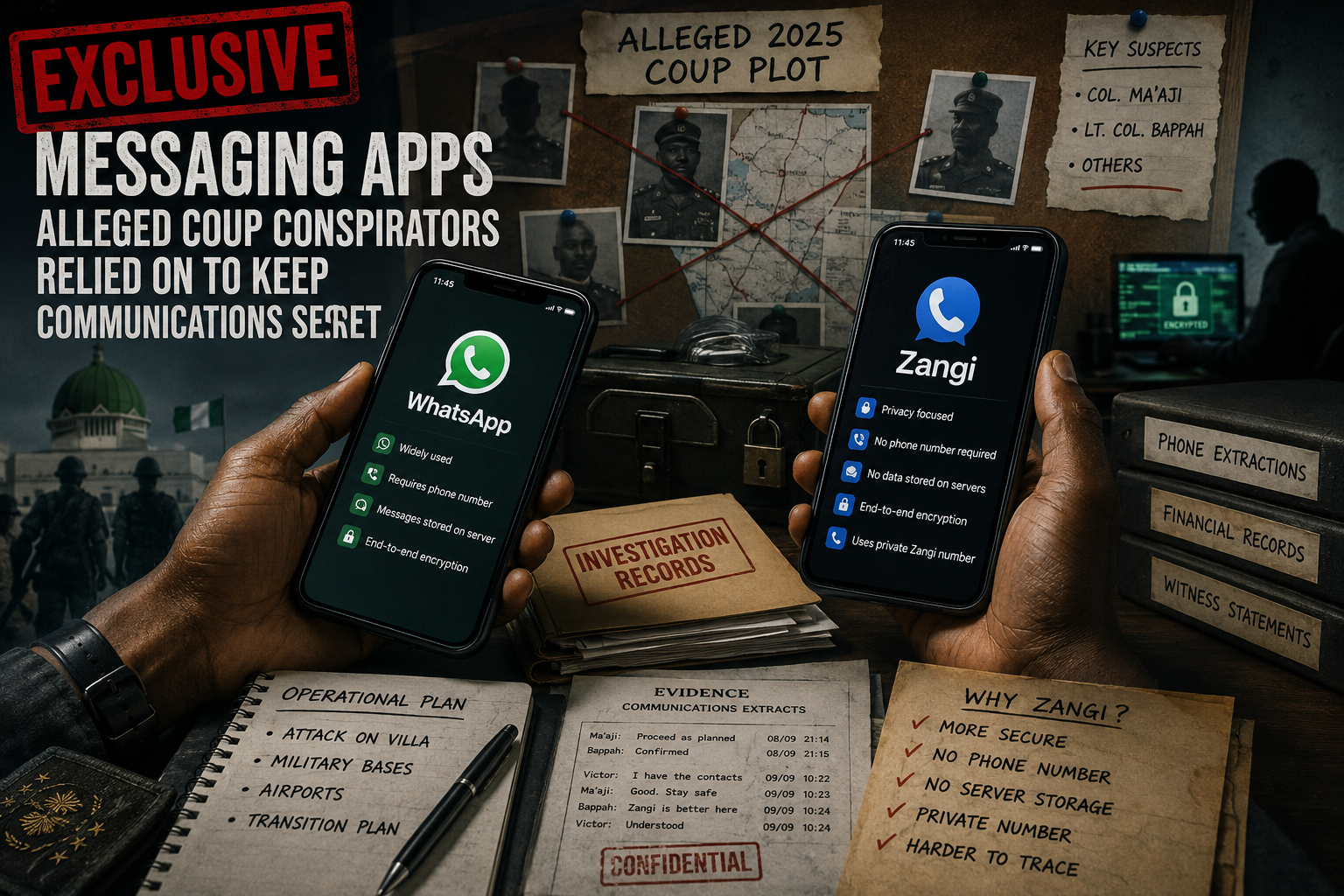
The way people communicate can be key to carrying out a plot or surprise.
For some people linked to the alleged coup case, communication went beyond regular phone calls. They used WhatsApp to send messages, and some discussions took place on Zangi, a lesser-known messaging app designed for privacy and secure chats.
This difference matters.
WhatsApp is one of the most popular messaging apps globally and is known by almost everyone with a smartphone. Zangi, on the other hand, focuses more on private conversations. The company claims it does not keep users' chat histories on its servers and that messages and calls have end-to-end encryption.
The choice of these apps is important because it was not just military officers chatting through any app on their phones.
In the context of an alleged plan to overthrow President Bola Tinubu, these apps were more than just tools for communication. They were part of the leads investigators followed to piece together the alleged conspirators' plans and identify their roles in the plot that authorities uncovered in September last year.
A retired navy captain, Erasmus Victor, faces charges with five others for 13 counts, including treason, linked to the alleged plot. He shared details about how one of the messaging apps played a role.
He explained what he knew about the alleged plot in a statement written during questioning by military investigators.
PREMIUM TIMES reported Mr. Victor's claims that he was asked to recruit financiers for the coup, a task he said he tried to avoid.
He mentioned being asked to pitch the coup to several potential sponsors, including Mr. Wike, to get their support and funds, but he never contacted any of them.
Mr. Victor, who shifted from military to politics, served as the chairman of the Ogu/Bolo Local Government Area of Rivers State from 2018 to 2021 while Nyesom Wike was governor. He also said he did not take the coup plot seriously and regretted not reporting it to the authorities.
His account is part of many investigation records obtained by PREMIUM TIMES.
Mr. Victor told investigators that the alleged mastermind, Mohammed Ma’aji, a Nigerian Army colonel, introduced him to Zangi as a safer option than regular phone calls.
He said he downloaded the app to talk with Mr. Ma’aji and Shamsuddeen Bappah, a lieutenant colonel in the Nigerian Army Signals Corps, whose name came up often in the investigation.
This detail is significant.
It shows that the app was introduced for specific conversations.


Zangi is less known to Nigerians compared to WhatsApp, but privacy is a big part of its identity. The tech company claims it does not keep chat histories on its servers. Instead, it says communication history is stored on users' devices. It also claims its end-to-end encryption is on by default, and decryption happens on users' devices.
Zangi differs from WhatsApp in another important way: you do not need a mobile number to register. Users get a private Zangi number instead. However, WhatsApp is planning to introduce a similar feature.
But that does not mean conversations on Zangi cannot be investigated.
The way Zangi is set up makes the device itself very important. If chat histories are kept on devices rather than a central server, investigators looking for evidence might focus more on the phones used by the participants rather than expecting the messaging company to provide a full record of conversations.
The evidence against the suspects in court contains many printouts of messages exchanged between them.
The term 'encrypted' can make chat records sound hard to access. But it is not.
End-to-end encryption aims to stop unauthorized people from reading messages while they are sent. It does not erase the devices where chats may be saved, nor does it remove all information around a communication.
A phone can have conversations, contacts, photos, files, notifications, and other data. Depending on the app and device, there can also be details about when a chat took place and who was involved.
This detail is crucial in an investigation focused on understanding relationships.
Investigators do not need to find every word exchanged between two people to show they were communicating.
A communication trail can become important alongside financial records, movements, meetings, witness statements, recovered documents, and other electronic proof.
That is why the choice of an encrypted app is interesting, but not the only factor.
Mr. Victor and others charged in the coup case have denied any wrongdoing. They also questioned whether the statements taken from them during investigations should be allowed in court, claiming they were obtained improperly. The prosecution disagreed and urged the court to accept the statements as evidence. But the court has not made a decision yet.
All claims in the statements, including Mr. Victor's, submitted to support the prosecution must be proven and do not mean anyone is guilty yet.






Comments
No comments yet.