Tinubu and Aregbesola met three times despite their feud, APC leader, Prof Adeyeye
Prof Sola Adeyeye shares insights on President Tinubu's approach to federalism and his attempts to mend ties with Aregbesola, highlighting their complex relationship.
The Director of Electioneering Planning for the All Progressives Congress (APC) 2027 Presidential Campaign in the South-West, Prof Sola Adeyeye, spoke with Ismaeel Uthman about President Bola Tinubu’s approach to federalism, his coalition efforts, and attempts to mend the relationship between Tinubu and former Osun State governor, Ogbeni Rauf Aregbesola.
In 2022, you opposed President Bola Tinubu’s presidential bid, but now you are leading his re-election campaign in the South-West. What has changed?
In the important details, nothing has changed. I did not oppose Tinubu as a candidate. Many people get that wrong. I opposed him as an aspirant during our party's primary in good faith. I chose to support who I felt was the best candidate for my party, Yemi Osinbajo. Once ‘aspirant Tinubu’ became the party candidate, I never spoke against him. The competition for candidacy within a party is like sibling rivalry, a family matter. Everyone should be free to choose whom they want.
Tinubu and I have things in common. I know some things about Tinubu that should remain confidential. He knows some things about me too. Neither of us should betray that trust. However, when I endorsed Osinbajo, Tinubu’s supporters began to attack him in ways I found offensive and unfair. They referred to him as Akintola (the former premier of the Western Region, Samuel Ladoke Akintola). I did not see any similarities between Osinbajo and Akintola.
What do you mean by similarities?
Akintola and Awolowo (the first premier of the Western Region and federal commissioner for finance) never vied for the same position. When Awolowo was premier, Akintola was in the House of Representatives, supporting Awolowo’s party. When Awolowo wanted to be Prime Minister, Akintola did not oppose him. They exchanged roles, and Awolowo did not block Akintola from becoming a premier.
Normally, Anthony Enahoro, who was deputy leader of the Action Group, should have led the party in the Western Region. At that time, the Midwest was part of the Western Region. But since Enahoro and Awolowo were both in the House of Representatives, maybe Enahoro should have led. However, they thought it would be hard for Enahoro to lead in an ethnocentric society like Nigeria against the NCNC (National Convention of Nigerian Citizens).
Yes, there were issues between Awolowo and Akintola, but it was not the same with Osinbajo. The claims that Osinbajo was Judas Iscariot were offensive to me. Judas Iscariot took money to betray his leader. No one has proven that Osinbajo took money to betray Tinubu. So, when they kept attacking, I felt we should also fight back. So, I said a few things that I perhaps should not have.
What has changed? Tinubu won the primary and became President. That is the change.
Are you now proud to have him as President?
Let me share some things Tinubu has done that make me proud. Anyone who knows my political journey knows I advocate for a federal system in Nigeria. Tinubu has done what no president has done since 1999 to lay the groundwork for federalism. Most presidents want to keep much of the money for the federal government due to their perceived heavy responsibilities. But Tinubu has allowed a slight increase in what states keep, helping many states to become economically viable. Without economic viability, no government can achieve anything.
Tinubu started giving states the power to control their police, which we had at independence but lost to military rule. If he only restores real federalism in Nigeria, he will be remembered as a great president.
There are about 195 countries worldwide, but only around 25 have a federal system. These countries are usually large, complex, and diverse. Nineteen of them have state or regional police.
Does that make Nigeria different?
Of all federal countries, Nigeria has the worst case of centralization in security and police power. England, even as a unitary system, has local police in various regions. But Nigeria has an abnormal situation.
When I was the Chairman of Ifedayo Local Government in Osun, the divisional police officer was from Otukpo in Benue State. He did not speak our local dialect, Igbomina. How could he effectively police a community whose language he did not understand? This is the absurdity we face. In the name of national unity, many who do not speak Yoruba have become police commissioners in Osun State, and it is the same in other states.
These are the issues I believe Tinubu will solve. When you claim sovereignty belongs to the people but deny them the power to enforce that sovereignty, you create chaos. That is what the centralization of a federal system causes. That is why I am very happy that Tinubu has taken steps toward federalism. In the Senate, I strongly supported state police. I fought for police powers for the states.
Is state police the only thing you admire about Tinubu’s government?
Another thing that impresses me about Tinubu is his loyalty to the ideals we fought for during our struggle for democracy. We once held a congress in Maryland, USA, led by Chief Anthony Enahoro, where I headed one of the committees. We agreed that any of us who became president must work hard to restore federalism. They must also quickly remove the anthem imposed by the military.
I never thought it would be easy, but I was surprised by how quickly Tinubu removed that military anthem. The constitution we have is not truly ‘we the people.’ It was written by the military, pretending to be the people. So, I commend Tinubu for remembering the decisions we made in the pro-democracy movement.
Many Nigerians are asking, given the country's economic challenges, why should they trust Tinubu with another four years?
What is the state of the country’s economy?
Some people complain about hunger, insecurity, inflation, and reduced purchasing power.
(Cuts in, then smiles.)
As Jesus Christ said, “the poor you will always have among you.” We pray for a Nigeria where we can reduce the number of poor people. Our people are not just poor; they are extremely poor. People often glorify the past as if it was better.
People talk about purchasing power: when you analyze Nigeria’s budget from 1999 to today and divide it by our population, you will see that there has not been a single year since 1999 where the Federal Government allocated one dollar for every Nigerian per day. We have always been very poor. Check the 2025 budget, and you will find that the government plans to spend less than $150 per Nigerian in a year. That’s about 45 cents per Nigerian daily.
Let’s discuss our external reserves: we are happy that it is now $57 billion. I applaud Tinubu for that. But that is still a sad figure. The total endowment of Harvard University, which has around 8,000 undergraduates, is equal to Nigeria’s entire external reserve. That’s a university in the US. When you see this, you realize how poor Nigeria is. Yet when we hear N31 trillion, we feel like a wealthy nation. Nigeria should be rich if it were well managed.

Norway, a country with a population similar to Ondo or Oyo states, has a budget that dwarfs Nigeria’s. Norway has about $32,000 to spend per citizen this year. In Nigeria, whether it is Tinubu, Atiku Abubakar, or Peter Obi, the government has less than $200 to spend on each Nigerian in a year. I think it was either Yar’Adua or Jonathan during whose leadership the figure got close to $268.
The reality is that we are sadly poor, and we must face that truth. We need to grow our economy. We need to adjust our spending to match our resources.
The APC came from a merger of different political parties and views. Yet, it has always presented itself as a progressive party, inspired by Chief Obafemi Awolowo and other progressive leaders. Do you think the party has stayed true to the principles it was founded on?
In Nigeria, we misuse terms. To be progressive means prioritizing the well-being and progress of individuals in government. If that is true, how can you, as a progressive, buy petrol from France without paying for it? The fact is, if we only shout ideological labels, we will fail. We must do what Awolowo did. When Awolowo introduced free education in Western Nigeria, he collected taxes for three years. That’s what cost him a federal election in the 1950s. He was the only one to lose an election in this region during free and fair elections because people complained about taxes without seeing benefits. But when free education started three years later in 1955, the Eastern Region led by Dr. Nnamdi Azikiwe tried to copy him. But free education failed in the East within two years because they hadn’t experienced the challenges Western Nigeria faced in setting it up. Growth is often painful.
Awolowo insisted that progressive politicians should be clear about their ideology and distinguish themselves from conservative politics. Does Tinubu’s formation of a rainbow coalition, with people from different backgrounds, show a break from that tradition?
No, because governing is different from winning elections. No matter how attractive your ideology is, you cannot implement it until you are in power. First, you must take power.
It was no surprise that even Awolowo’s party formed a coalition with the NCNC in 1964, which was a mistake when they boycotted that election. Many forget that during Awolowo's time, there was a coalition called the Progressive Party Alliance in 1980. They were progressive only in name. While the PRP (People’s Redemption Party) of Aminu Kano and the UPN (Unity Party of Nigeria) were genuinely progressive, the GNPP (Great Nigeria People’s Party) and MPP (Movement of the People Party) were not ideologically aligned. But they recognized that they had a bigger enemy in the NPN (National Party of Nigeria) to confront.
The PPA had a majority, and if they had acted united, they could have defeated Shehu Shagari in 1983. So I understand anyone who says, to prevent a greater evil, they must form any alliance necessary.
Do you think Awolowo would approve of Tinubu’s political style today?
I cannot speak for Awolowo. The last time I spoke with him was in 1980. Anything I say would be speculation.
Awolowo respected data. His opponents often complained that he only quoted figures. But Nigeria has a problem with ignoring figures. We do not analyze the data needed to run our nation. Therefore, we propose ideas that are not sustainable in the long run.
People are complaining about petrol prices now. Is there any commodity in the world that can have a competitive price if the supplier is a monopoly? In Nigeria, petrol supply comes from a monopoly. We only have Dangote Refinery. That company borrowed money to set up. We call Alhaji Aliko Dangote the richest man in Africa, and yes, he is. But he owes billions in loans. So do people expect him to borrow and not pay back? Do they expect him to not make a profit? The high cost of petrol is because the last refinery built in Nigeria was during Muhammadu Buhari’s first term. We have not had a new refinery in over 40 years. The government’s existing refineries are not functioning.
I hope that when Tinubu wins, he will prioritize building a new, modern refinery. Why should a country with nearly 250 million people have only one refinery? I pray that Tinubu makes energy and electricity his top priority. If we have affordable petrol and electricity, our people can thrive. They are not lazy. Their creativity will flourish. Many companies leaving Nigeria are not going because Nigerians are lazy. They are leaving because they cannot sustain operations on diesel. That is the issue.
You have maintained good relationships with both Tinubu and former Osun State governor, Ogbeni Rauf Aregbesola, who are now on opposite sides politically. What do you think caused the rift between them?
Honestly, I do not know. They both liked each other. I just hope they will reconcile soon. That is my prayer.
Naturally?
Well, some people need to help make that happen.
What have you done to bring them together?
I have done everything I could, but I will not say more. My prayer is that they will reunite.
Is there any conspiracy blocking your efforts to reconcile them?
I do not think so. Even if there is, it does not bother me. Some people enjoy disputes. But in the end, both must take responsibility for being close friends whose relationship has soured. I believe God will heal it. By God’s grace, they will come together again.
How soon will that be?
I cannot say. It is not up to me. It depends on them.
Have they met since the rift started?
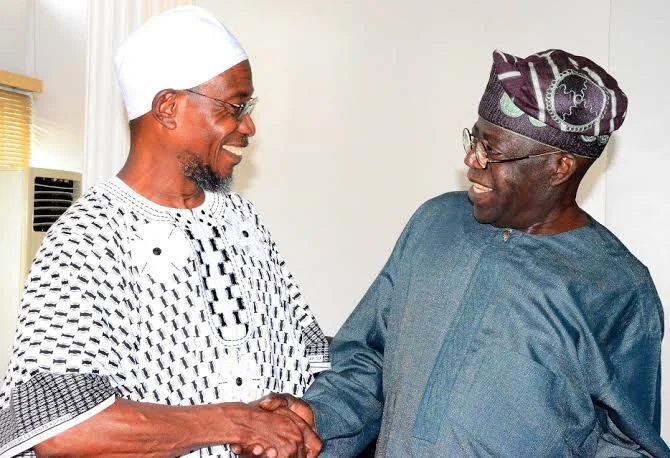
I know they have met about three times since their disagreement began. When two people have deep feelings for each other and feel betrayed, the hurt is stronger. But time can heal, and I believe healing is already happening.
Comments
No comments yet.