Africa's Call for a Permanent Seat at the UN Security Council
Africa is advocating for a permanent seat at the UN Security Council amid calls for reform. The challenge lies in achieving unity on candidate countries.
Africa needs to keep pushing for changes in the UN Security Council, even if it may take time. But if asked today to pick the two countries for permanent seats without veto power, African unity would be tested. The Biden administration said in September 2024 it would back this idea. Washington knows how tough it is for any region to agree on who should fill new seats.
The 81st UN General Assembly met with the theme "Restoring trust, managing transformation: A United Nations that delivers for all." I watched the General Debate carefully. Leaders from different countries called for reform of the United Nations for various reasons. Smaller nations want the Security Council changed to include more voices. Some also want an end to the veto power held by the five permanent members: China, France, Russia, the United Kingdom, and the United States.
As I listened, I wondered if Africa will ever have a permanent voice at the table where decisions about war and peace are made, and on what basis it should continue to seek this.
Brazil and the US Start the Discussion
Tradition has Brazil opening the General Debate, which happened on 22 September. President Luiz Inácio Lula da Silva stood for multilateralism at a time when major powers lean towards unilateral actions. He repeated Brazil’s long-standing call to expand the Security Council with new permanent members.
President Donald Trump followed as is customary for the host country's leader. He defended the war against Iran, saying, “while others have talked, I have acted.” He mentioned having to choose between a deal with Tehran and destroying it. He called the International Criminal Court “an evil group of people” and urged member countries to leave. Africa was hardly mentioned; deals involving Africa were made on the sidelines.
Mia Amor Mottley Speaks for Africa
Prime Minister Mia Amor Mottley of Barbados continues to inspire pride among Africans, both on the continent and in the diaspora. In a world where African voices are often sidelined, her boldness is refreshing. However, this same boldness means she is unlikely to be considered for the role of the next Secretary-General.
While speaking to the Assembly on 24 September, she called for the Caribbean to remain a peaceful zone. Regarding Haiti, she supported the promised deployment of the 5,500-strong Gang Suppression Force and the renewal of its mandate, stating: “Enough is enough.” She also spoke in favor of Cuba and emphasized the need for dialogue based on sovereign equality.
Mottley connected slavery to the current global order. She argued that the attitudes that allowed slavery to exist still contribute to inequalities in the UN’s power dynamics and international financial systems. She also stated that the Caribbean does not seek reparations without also accepting responsibility for self-improvement. No African leader articulated this better. In that hall, Mottley was an African speaking for all.
She also made the reform issue clear. While supporting permanent membership of the Security Council for Africa, she pointed out that it is not just about who sits at the table, but how power is used at that table. Africa should keep that thought close.
Accra, Nairobi, and Abuja Sing the Same Tune
President John Dramani Mahama of Ghana spoke in the spirit of Nkrumah. He pointed out that Africa, with 1.5 billion people, represents over 18 percent of humanity and is the largest regional voting bloc in the General Assembly. On this basis, he demanded permanent African representation on the Security Council with full veto powers.
He highlighted the March 2026 resolution brought by Ghana and supported by 123 nations, which declared the transatlantic slave trade the gravest crime against humanity, the same resolution that Mia Mottley celebrated. He argued that real repair means ending unfair trade practices, biased credit ratings, unsustainable debt, and exporting raw materials without adding value. He insisted that Africa’s essential minerals be processed on the continent. He condemned corruption in Africa twice.
Africa should argue from a position of development. With 1.5 billion people, the world’s youngest population, and the minerals essential for the energy transition, Africa has a legitimate grievance. The rules of finance, trade, and climate are made without its input. That was Mahama at his best, and Ruto on credit ratings. A continent that seeks power to lift its people out of poverty makes a stronger case than one that asks for power just because it appears frequently on the Council’s crisis list.
President William Ruto of Kenya noted that every country has one vote in the Assembly, yet five nations hold permanent power that the other 188 do not. Africa has 54 member states and over a quarter of the Assembly but lacks a permanent voice and is often the subject of Council decisions: “permanently discussed, yet permanently excluded.” He countered the claim that reform is impossible by recalling that in 1963 the Assembly changed the Charter to increase the Council from eleven to fifteen members.
He pointed out that developing countries borrow at rates two to four times higher than developed nations, and biased credit ratings have cost Africa around $75 billion. To his credit, he admitted that reform abroad cannot replace accountability at home, including tackling corruption decisively.
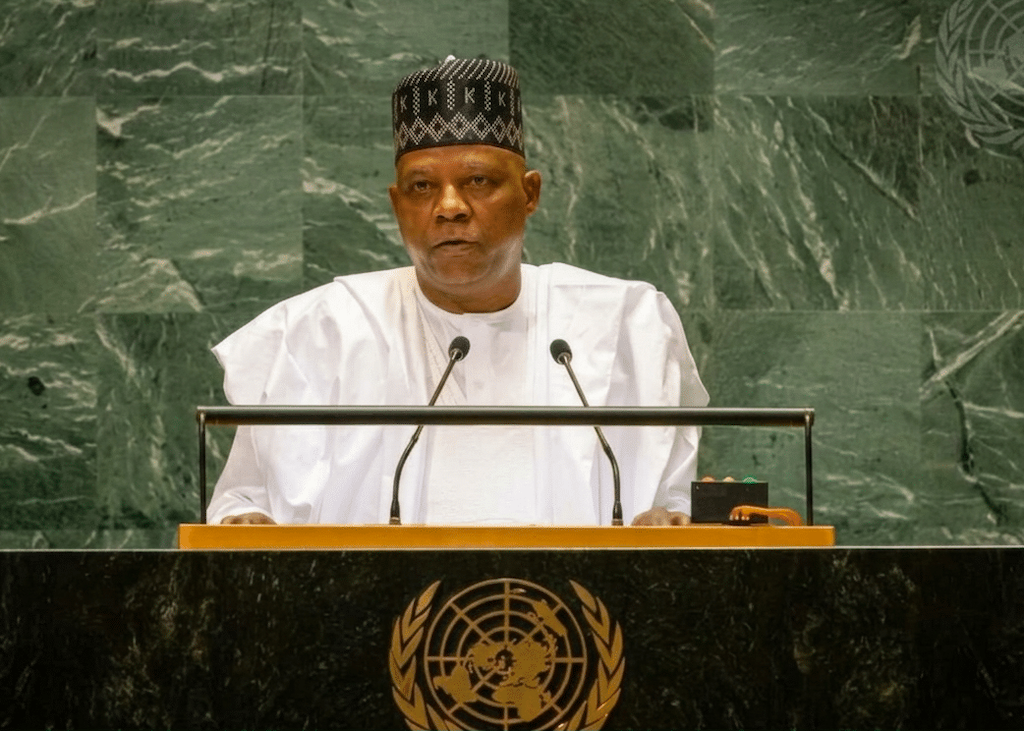
Nigeria's Vice President Kashim Shettima delivered President Bola Tinubu’s statement. He demanded at least two permanent seats for Africa with veto power, as long as it exists, and five non-permanent seats, in line with the Ezulwini Consensus and the Sirte Declaration. His strongest point was that “the world of 2026 cannot remain captive to the distribution of power in 1945.” He mentioned Nigeria's readiness for greater responsibility, citing its sacrifices in Liberia, Sierra Leone, Mali, and The Gambia, along with its mediation and security efforts through ECOWAS, the AU, and in the Gulf of Guinea.
Having been part of those efforts, I can confirm that Nigeria’s peacekeeping record is real. But as the saying goes, past actions do not guarantee future outcomes. Nigeria's contributions in Liberia, Sierra Leone, and elsewhere are commendable, but they belong to history now. A permanent seat is not a reward for past actions; it is about what a country can offer today. A Nigeria that struggles to secure its own highways will have a hard time convincing the world it can handle the responsibilities of a permanent seat with veto power.
Our Conflicts Are Not Our Credentials
Here is where I differ with the argument I often heard that week. It goes like this: because the Council spends much time discussing Sudan, Somalia, South Sudan, the Sahel, and eastern Congo, Africa deserves a permanent seat to influence those decisions. Ruto’s term “permanently discussed” highlights a real frustration. But I do not believe a continent’s conflicts are its credentials.
Conflict is a sign of governance and development failures, many of which are self-inflicted. A claim based on being the Council’s most frequent agenda item is a claim based on a negative aspect. Peacekeeping contributions, as significant as Nigeria’s have been, show commitment but do not prove the ability to prevent future wars.
Africa should argue from a development perspective. With 1.5 billion people, the youngest population globally, and the minerals crucial for energy transition, Africa has a legitimate grievance. That was Mahama at his best and Ruto on credit ratings. A continent that seeks power to lift its people out of poverty has a stronger case than one that asks for power because it often appears on the Council’s crisis list.
The G20 Lesson
I agree with Mia Amor Mottley, a great daughter of Africa rising in the spirit of Mandela and Nkrumah: the issue is not just about the seat, but how power is wielded from it. We have seen this before. When Jeffrey Sachs suggested that Africa be given a seat at the G20, I argued against viewing the seat as the solution. My point was that a seat does not feed a hungry child; what matters is how Africa’s leaders use it and whether governance improves at home.
Africa got the seat. The AU joined the G20 officially on 9 September 2023. It attended its first summit as a full member in Rio de Janeiro in November 2024, and in November 2025, the G20 met on African soil for the first time, in Johannesburg.
What has changed for Africa’s poor? According to the World Bank’s April 2025 Africa’s Pulse, about 80 percent of the world’s estimated 695 million extremely poor people lived in Sub-Saharan Africa in 2024. The Bank estimated that the number of extremely poor people in the region would rise by 90 million between 2022 and 2027. Nigeria alone accounts for 19 percent of the region’s extreme poor, over 106 million people.
A seat at the G20 has not changed these numbers. Without better capacity at home, a seat becomes just a photo opportunity with a flag.
As Mottley rightly pointed out, the matter is not just about who sits at the table but how power is used. When and if a seat comes, that will be the real test. With 54 of the 193 members of the General Assembly, Africa must produce a clear leader: a country that can pay its own bills and lift its people out of poverty and squalor.
A Permanent Seat for Africa: Dream or Negotiation?
I must be realistic about the permanent seat. Any expansion needs a Charter change. This requires a two-thirds vote in the General Assembly and then ratification by two-thirds of member states, including all five permanent members, any of whom can block it.
The challenges are significant. There is the veto issue. There is the Uniting for Consensus group. And Africa itself has not resolved which two countries would hold the seats: Nigeria, South Africa, Egypt, Ethiopia, and Kenya are all contenders, while smaller nations have pushed for any seat given to Africa to rotate. Together, these factors make Africa’s desire seem like a distant dream.
Yet, there are chances for change. The Pact for the Future commits member states to address the historical injustices against Africa as a priority. The 1963 Assembly change shows that the Charter can be amended. A new Secretary-General will take office in January 2027, and Ghana will chair the AU that year. Africa must agree on its candidates, speak with one voice, and focus on development rather than distress. Then the seat is no longer a dream deferred; it becomes a negotiation the P5 cannot delay indefinitely.
Djibouti Brings It All Together
HE Abdoulkader Houssein Omar, Djibouti’s Minister of Foreign Affairs and International Cooperation, made his country’s statement on 26 September. He highlighted the thousands fleeing Yemen into Djibouti’s Obock region. He called on the world to safeguard the security gains in Somalia. He welcomed Sudan’s return to IGAD, which Djibouti currently chairs, and urged against negative external interference in Sudan.
He reminded the Assembly of the Djiboutian prisoners of war held by Eritrea for more than eighteen years. Like many African nations and indeed much of the world, Djibouti expressed solidarity with the Palestinian people and support for the two-state solution.
The Minister also spent time discussing development, under the 2030 Sustainable Development Goals and the AU’s Agenda 2063. He shared that Djibouti is creating a national carbon-market framework under Article 6 of the Paris Agreement. He called for the Seville Commitment on financing for development to provide concessional finance and debt sustainability. Djibouti’s voice carries weight beyond its size.
Conclusion
Africa should keep pushing for changes in the Security Council, even if it may take time. But African unity would be tested if asked today to choose the countries for the two permanent seats without veto power, which the Biden administration said it would support in September 2024. Washington knows how difficult it is for any region to agree on who should fill those seats.
So why create tension over something unlikely to happen soon, given the known disagreements on this issue within Africa, Europe, South and South-East Asia, and Latin America? Africa must argue from strength, focusing on its development challenges, including the more pressing vetoes at the Bretton Woods institutions.
As Mia Mottley rightly said, the issue is not just about who sits at the table but how power is used. When and if the seat comes, that will be the real test. With 54 of the 193 members of the General Assembly, Africa has no excuse for failing to produce a clear leader: a country capable of paying its own bills and lifting its people out of poverty.
Comments
No comments yet.