Jigawa's Journey: Governor Namadi's Role in the State's Growth
Jigawa State has transformed since its creation in 1991. Governor Namadi aims to boost the economy and improve education and healthcare in the state.
When Jigawa State was created on 27 August 1991, it faced the tough job of building almost everything from the ground up. Dutse, the capital, was just a small rural area. The new government had few roads, schools, or hospitals to work with.
Thirty-five years later, things have changed a lot.
Jigawa now has a functioning government, 27 local councils, universities, an international airport, better roads, and more healthcare facilities. This change did not come from just one government. It was a team effort by military leaders, different civilian governments, civil servants, traditional leaders, development partners, private businesses, and, most importantly, the people of Jigawa.
Governor Umar A Namadi's administration is just another chapter in this ongoing story.
When Namadi took office on 29 May 2023, he found a state that had strong foundations but also serious problems. The economy relies heavily on farming, there is widespread poverty, not enough teachers or healthcare workers, many children not in school, and regular flooding along the Hadejia River.
His plan is to focus on boosting the economy and improving people's skills. He uses the 12-point Greater Jigawa Agenda as his guide.
Building on the foundation
Jigawa's development has gone through different stages.
Military leaders and the first civilian governor built the basic systems of the state in the 1990s. Under Governor Ibrahim Saminu Turaki, the state worked on decentralizing government, finding new ways to generate revenue, and starting early ICT programs. Then Governor Sule Lamido improved infrastructure, developed Dutse, and set up Jigawa State University, now called Sule Lamido University.
From 2015 to 2023, Muhammad Badaru Abubakar governed during tough economic times. He focused on managing funds wisely, avoiding debts, renegotiating contracts, finishing projects started by previous leaders, and making sure salaries were paid.
Namadi took over this built-up foundation.
His unique approach combines strict financial management with a strong focus on investing in infrastructure. The state budget increased from ₦698.30 billion in 2024 to ₦756.30 billion in 2025 and ₦901.84 billion in 2026. In 2026, ₦693.40 billion, or 76.9 percent, is set aside for capital projects.
What matters is not just the budget size but where the money goes: agriculture, roads, healthcare, education, energy, and environmental protection.
Agriculture as an economic strategy
For Jigawa, farming is not just an industry. It is the backbone of the state’s economy and the main source of income for about nine out of ten working people.
The government aims to shift from short-term support to more commercial farming.
Wheat farming has increased from around 55,000 hectares to over 70,000 hectares, with future targets of 120,000 and 250,000 hectares. The Rice Millionaires Programme aims for 500,000 hectares by 2030 to meet half of Nigeria’s rice needs.
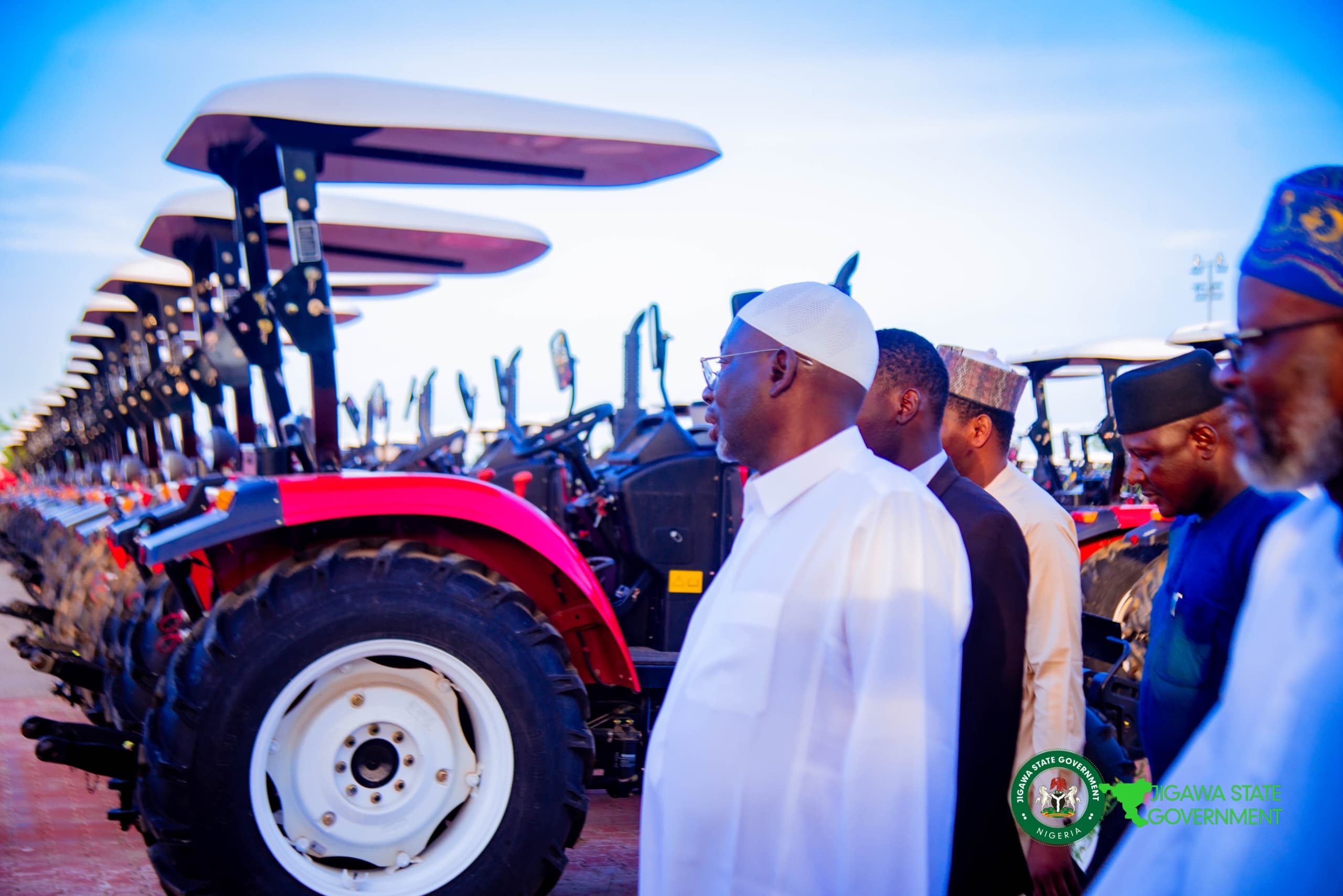
The strategy includes using machines. The government set up the Jigawa Farm Mechanization Service Company, buying 300 tractors and 60 harvesters. Thirty young engineers were trained in China as master tractor technicians.
Through J-AGRO, 1,500 extension agents and 300 animal health workers have been sent to help farmers. A ₦6 billion funding deal with the Bank of Industry is meant to make it easier for farmers to get loans.
The bigger opportunity comes after farming.
With crops like wheat, rice, sesame, hibiscus, and groundnuts, Jigawa has what it takes for a wider agro-industrial economy. The revival of the Maigatari Border Free Trade Zone and the approval for a SON Halal Testing and Certification Laboratory in Dutse are steps to connect local production with larger markets.
Success will be measured by how much of Jigawa’s agricultural value stays in the state through processing and manufacturing.
Investing in people
The second major focus of the administration is on people.
The education sector has a shortage of over 10,000 teachers in basic schools. Under J-Teach, 3,000 temporary teachers became permanent staff, and another 1,100 senior secondary teachers were confirmed. Thousands more have been hired, including 4,000 Batch C candidates.
But it is not just about hiring. Many teachers have gone through competency tests, and ₦500 million has been set aside for their training.
The government also created the Tsangaya Education Board to teach basic skills alongside traditional Quranic studies.
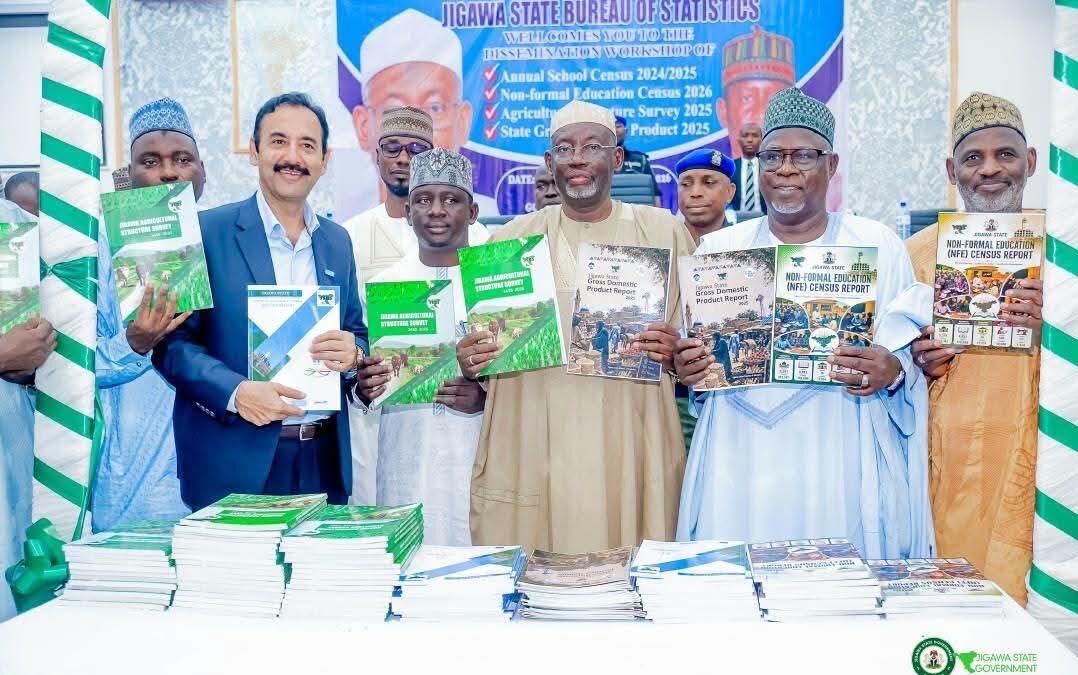
At Sule Lamido University, over ₦26 billion has been earmarked for new buildings, including a Faculty of Medicine and hostels. Scholarship funds increased by up to 100 percent for 34,331 local students and 231 foreign students studying medicine and engineering.
The administration bought Khadijah University, Majia, for ₦11 billion and changed it to Jigawa State University of Medical and Allied Health Sciences, Majia. This move helps train more doctors, nurses, and medical professionals, boosting the state’s ability to supply skilled workers for its healthcare system.
Healthcare also received attention.
Over 3,000 health workers have been hired, and from December 2024, salaries will match the federal pay scale. Of 281 primary healthcare centers funded by the government, 67 have been upgraded with solar power, water, and staff housing.
The state has expanded specialized healthcare, adding new general hospitals and improving existing ones, along with free hemodialysis services.
In total, ₦2 billion was allocated to JICHMA for the J-Basic Health Package, giving free basic healthcare to over 200,000 vulnerable residents.
These investments show a wider understanding of development. Roads and buildings are important, but so are the teachers, doctors, and skilled young people who help the state run.
Infrastructure and resilience
The administration's infrastructure plan aims to link production, markets, and public services.
Road contracts for about 978 kilometers have been awarded, with over ₦304.7 billion committed. The 2026 budget sets aside another ₦186.37 billion for transport.
The government also cleared ₦82 billion in old project debts and completed over 300 kilometers of roads while starting new road connections.
Energy is another key focus. The Ministry of Power and Energy was created, and the Jigawa State Electricity Law was enacted. The state also bought a 10 percent stake in KEDCO to boost its role in electricity development. The 2026 budget allocates ₦50.7 billion for rural electrification, solar projects, and mini-grids.
For a state that relies on farming, being prepared for climate issues is also vital.
Over 159 kilometers of river channels blocked by silt and Typha grass are being cleared, and 132 kilometers of flood barriers have been built. Concrete drainage systems have been put in place in 32 locations.
These efforts address problems that have often threatened lives, farms, and infrastructure in the Hadejia basin.
The frontier ahead
The scale of Namadi’s program is big, but the real test is what these investments will achieve.
More teachers must mean better education. More health workers must bring better healthcare. More land for farming should lead to higher production and processing. Roads and electricity must aid businesses and create jobs. Digital reforms must make government work better.
There is also the issue of sustainability. The 2026 budget relies heavily on federal funds and capital receipts, while the state has set a target of ₦88.9 billion in local revenue. Expanding the economy will be key to keeping investments going.
This is the next step in Jigawa’s development.
The state has spent 35 years building institutions and infrastructure. The next challenge is to make these assets create more economic value and improve the lives of its people.
That is where Governor Namadi fits into Jigawa’s story.
He did not create the foundation. He took it over.
His goal is to build on that foundation and push the state into a phase of more investment and productivity. This means making agriculture more business-focused, improving human skills, ensuring infrastructure supports production, making government digital, and helping communities prepare for challenges.
The success of this chapter will be measured not by flashy headlines but by what remains when this administration becomes part of Jigawa’s history.
If institutions are stronger, the economy is better, the people are more skilled, and the state is more resilient, then Namadi’s chapter will have achieved what every successful phase in Jigawa’s 35-year journey has done: build on what was left behind and leave a stronger foundation for the next generation.

Comments
No comments yet.