Kaduna 2027: Political Tensions Rise Among Uba Sani, Ashiru, and La’ah
The race for the Kaduna governorship in 2027 heats up with Uba Sani, Isah Ashiru, and Danjuma La’ah competing for power. Each candidate brings unique strengths to the contest.
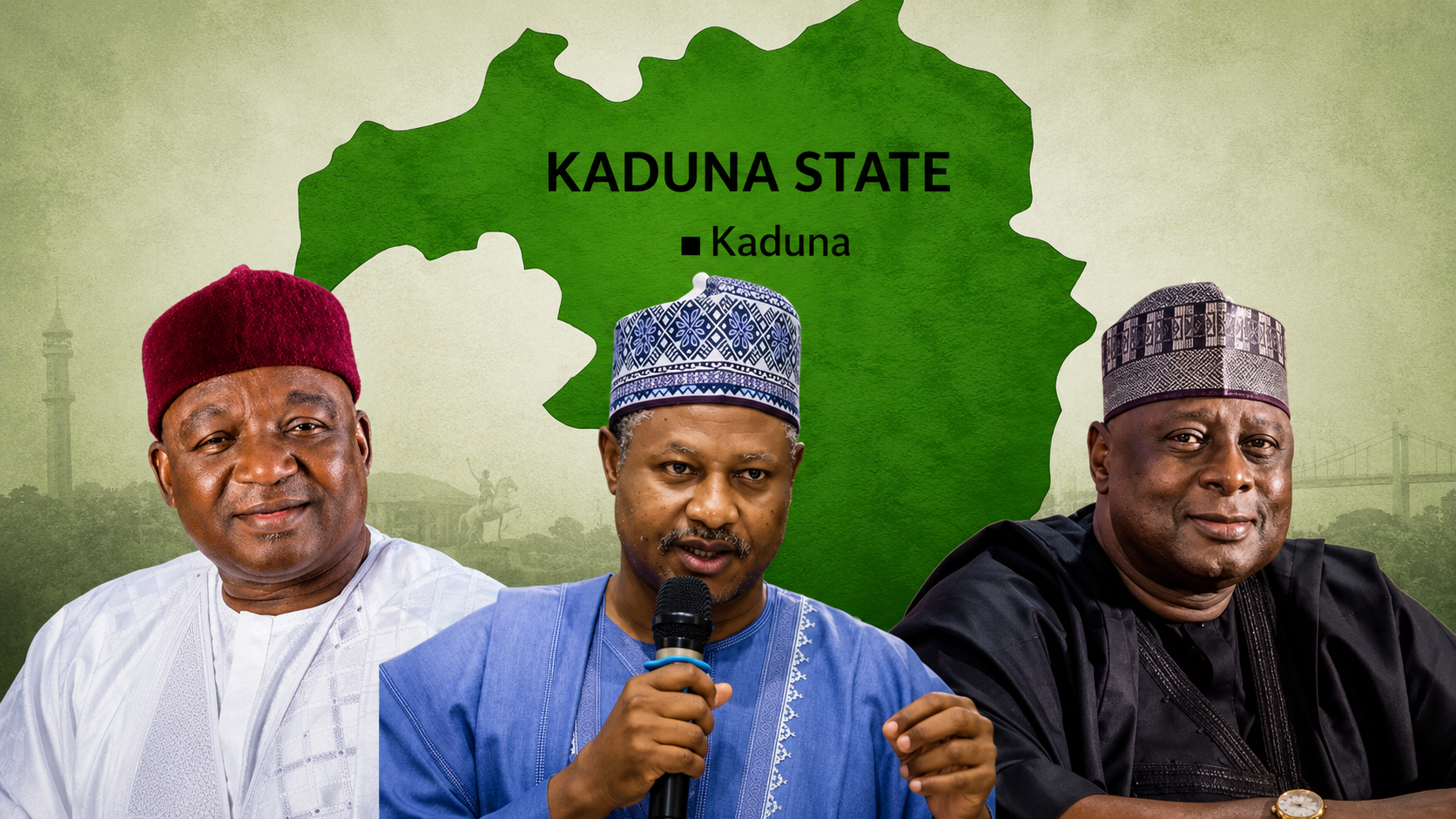
The 2027 election season is heating up, and Kaduna State is already in the thick of it.
The Independent National Electoral Commission (INEC) has set 19 August as the start date for campaigns for the presidential and National Assembly elections. For the governorship and State House of Assembly elections, campaigns will kick off on 9 September 2026. The governorship election is scheduled for 6 February 2027, with campaigns ending a day before.
In Kaduna, this countdown adds pressure to an already intense race.
Governor Uba Sani of the All Progressives Congress (APC) is vying for a second term against Isah Ashiru of the African Democratic Congress (ADC). Former senator Danjuma La’ah has also joined the race under the Nigeria Democratic Congress (NDC).
These three candidates are coming from different political angles.
Governor Sani enters the contest with the advantage of being in power, access to government resources, and a strong APC backing. Mr Ashiru is well-known across the state, having run for governor twice before and built a solid political network. Mr La’ah has two Senate terms under his belt, a strong Southern Kaduna identity, and is arguing that the governorship should now go to Kaduna South.
But the key question is whether the opposition can unite their strengths into a single force.
New Phase in Kaduna Politics
Kaduna politics has always been complicated. The three senatorial zones have different political identities, and factors like religion, ethnicity, geography, insecurity, and old regional grievances shape political behaviors.
One major aspect of Kaduna politics is that alliances are often temporary. This current race shows that clearly.
Mr Sani was once close to former Governor Nasir El-Rufai. He took over from activist politician Shehu Sani as senator for Kaduna Central and was El-Rufai’s chosen successor in 2023. Now, they are political rivals.
Mr El-Rufai has left the APC for the ADC, and many members of his political network are now with Mr Ashiru. This shift has changed the political landscape for the 2027 election.
Mr Sani and the Advantage of Incumbency
Governor Sani has the strongest institutional support among the candidates.
He controls the government and heads a ruling party that has grown its influence since 2023.
He won the APC governorship ticket without opposition, receiving 459,393 votes at the party primary.
Most importantly, the governor has attracted politicians from outside the APC. Former governor Ramalan Yero, former senators Shehu Sani and Suleiman Hunkuyi, among others, joined the APC in 2025. Mr La’ah also switched to the ruling party before leaving for the NDC.
Twelve opposition lawmakers also moved to the APC, further boosting the party's strength in the state.
This shift is not just about numbers.
Mr Sani is building a political base that goes beyond traditional APC supporters.
But the governor's strength could also be a weakness.
A powerful ruling party can become overconfident, especially when its members believe victory is certain. Opposition parties will try to use that overconfidence to argue for change.
Ashiru: The Familiar Challenger
For Mr Ashiru, 2027 is another chance to reach Sir Kashim Ibrahim House.
He ran for governor in 2019 against El-Rufai and again in 2023 against Mr Sani. His second-place finish in 2023 shows he has a strong following.
His move to the ADC has also put him at the center of a larger opposition shift.
Mr El-Rufai's entry into the ADC has created a unique situation.
Mr Ashiru used to run against Mr El-Rufai.
Now, parts of the former governor’s network are backing his campaign.
Bashir El-Rufai’s public support for Mr Ashiru after the ADC primary has fueled talk about this new alliance.
But Mr Ashiru faces a tough challenge: this is his third try.
The ADC must convince voters that 2027 is different from 2019 and 2023.
They also need to solve internal issues regarding their governorship primary, which have raised doubts about unity.
The El-Rufai Factor
No talk about Kaduna 2027 can skip Mr El-Rufai.
The former governor built a powerful political network during his eight years in office.
His split from his successor, Mr Sani, has become more than just a personal disagreement.
It is now part of a bigger struggle over who will shape Kaduna’s future.
The feud has included arguments over governance, finances, and security.
Mr El-Rufai has criticized some of Mr Sani’s strategies for dealing with banditry. Meanwhile, the governor defends his mix of security operations, dialogue, and socio-economic programs to tackle the issue.
Mr Sani believes that military force alone will not solve insecurity.
This disagreement could become a campaign topic.
For the opposition, Mr El-Rufai’s influence could be a big plus. But it’s also risky.
Too much association with him could energize his followers while also bringing back memories of his controversial time in office.
Mr Ashiru needs to use the El-Rufai network without allowing the election to turn into simply a referendum on the former governor.
La’ah and the Southern Kaduna Calculation
Danjuma La’ah adds a new angle to the race.
He is a former two-term senator representing Kaduna South and remains a key figure in Southern Kaduna.
His political journey has been quite dynamic.
He previously opposed Mr El-Rufai in the Senate, then joined the APC under Uba Sani, and left after losing the APC primary.
Now, he is running for governor with the NDC. His main argument is about political rotation.
Mr La’ah claims that Kaduna North has produced governors like Namadi Sambo, Ramalan Yero, and Mr El-Rufai, while Uba Sani is from Kaduna Central.
He insists that Southern Kaduna should now have the governorship.
That message could resonate well in the region. But winning Kaduna requires more than just Southern Kaduna votes.
Mr La’ah must show he can gather support in Kaduna North and Central to become a candidate for everyone.
The Third-Force Problem
Mr La’ah’s entry could be crucial even if he does not win.
The question is whether he will split the anti-APC votes.
Mr Ashiru has a solid statewide base.
Mr La’ah has a strong backing in Southern Kaduna. Both could attract voters unhappy with the APC.
If they remain separate, Governor Sani might gain from the division.
This is the key math of the election.
The opposition does not need to outshine the APC. They just need to work together better.
Insecurity Remains the Biggest Issue
Security will likely dominate the campaign.
Kaduna has faced years of banditry, kidnappings, and communal fighting.
Mr Sani’s administration can highlight security initiatives, negotiations that helped free kidnapped residents, and efforts to reopen farms and communities.
But attacks are still happening.
Recent killings and kidnappings in Birnin Gwari and other parts show that insecurity is a daily worry for many rural areas.
The political argument is clear.
The government will claim that things have improved and that their strategy is working. The opposition will argue that the improvement is not enough while farmers are still scared to go to their farms and travelers remain at risk.
For a farmer, the question is simple:
Can I leave home, go to my farm, and come back safely?
That question could matter more than any campaign slogan.
Cost of Living and Everyday Governance
Security is not the only issue.
People are also facing high housing costs, unemployment, water shortages, and the general cost-of-living crisis.
These problems will challenge Governor Sani’s development story.
His administration can point to infrastructure, healthcare, water projects, and other programs.
But the opposition can question whether these investments are truly making life better for everyday Kaduna people.
The needs of a civil servant in Kaduna city may look very different from those of a farmer in Birnin Gwari or a trader in Southern Kaduna. That makes campaigning across the state particularly tough.
What Kaduna Voters Are Saying
Kaduna residents who spoke to PREMIUM TIMES expressed frustrations about rising inflation, unemployment, housing costs, and access to basic services.
PREMIUM TIMES has reported rising rents in Kaduna city, with residents complaining about sharp increases that have made housing unaffordable for low- and middle-income families.
Water Supply Remains Another Concern in the State
These issues could weaken the government’s development claims if voters feel that big infrastructure projects have not led to real improvements in their lives.
There is no solid statewide opinion poll that shows a clear favorite.
Mr Sani himself has cautioned against confusing social-media fame with actual electoral support.
He argued that someone could be popular online but still lose at the polls, emphasizing that the real test is grassroots engagement.
This is especially vital in Kaduna.
The election will be fought at the ward and polling-unit level.
The ability to organize agents, rally voters, reach rural communities, and protect the vote might matter more than online popularity.
Mr Ashiru’s past campaigns give him an edge in this area.
The APC’s established structure gives Governor Sani an even bigger advantage. Mr La’ah of the ADC now has to create his own.
APC’s Power and Its Limits
The APC has the stronger political machinery right now.
They have incumbency, federal support, lawmakers, local structures, and a growing network of former opposition politicians.
But just being dominant does not guarantee voter loyalty.
Mr Ashiru’s shift from being Mr El-Rufai’s opponent to a politician who could gain from parts of the former governor’s network is one clear sign of Kaduna’s changing political scene.
The campaign is about to officially begin, but the real contest has already started.
INEC’s updated schedule gives the parties a clear timeline.
Presidential and National Assembly campaigns start on 19 August, while the governorship campaign in Kaduna starts on 9 September.
Campaigns must end 24 hours before election day, with the last day for governorship campaigning set for 4 February 2027. The governorship election will take place on 6 February.
This tight schedule means candidates can’t afford long internal fights.
For the APC, the challenge is to stay united and convince voters that Governor Sani deserves another four years.
For the ADC, the focus is on rallying behind Mr Ashiru and sorting out their internal issues.
For the NDC, the immediate task is to resolve the dispute over their governorship ticket and provide La’ah with a solid platform.

Comments
No comments yet.