WSCIJ to hold discussion on journalism and civic space in Nigeria
The Wole Soyinka Centre for Investigative Journalism will hold a virtual event on November 10 to discuss journalism and civic space in Nigeria. Key speakers will evaluate current challenges and propose solutions.
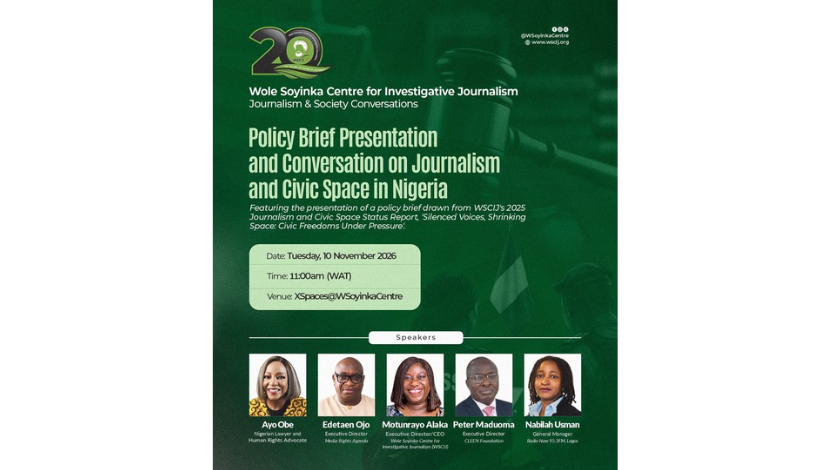
The Wole Soyinka Centre for Investigative Journalism (WSCIJ) has announced its November edition of the Journalism and Society Conversations. The theme is “Policy Brief Presentation and Conversation on Journalism and Civic Space in Nigeria”.
Motunrayo Alaka, WSCIJ’s CEO, said in a press statement on Tuesday that the virtual event will gather important decision-makers. They will evaluate the state of journalism and civic freedoms in Nigeria. They will also discuss ways to improve accountability and protect journalists and civic space.
The event is set for Tuesday, 10 November, at 11 a.m. on X.
One of the main highlights will be a policy brief based on the centre’s 2025 status report, titled “Silenced Voices, Shrinking Space: Civic Freedoms Under Pressure.”
Speakers
The panel will include important figures like human rights lawyer Ayo Obe, Peter Maduoma, the executive director of the CLEEN Foundation, Edetaen Ojo, the executive director of Media Rights Agenda, and Motunrayo Alaka, the CEO of WSCIJ.
Nabilah Usman, general manager of Radio Now 95.3 FM, will moderate the conversation.
The policy brief
The 2025 Journalism and Civic Space Status Report, “Silenced Voices, Shrinking Space: Civic Freedoms Under Pressure”, looks at reported violations of civic space.
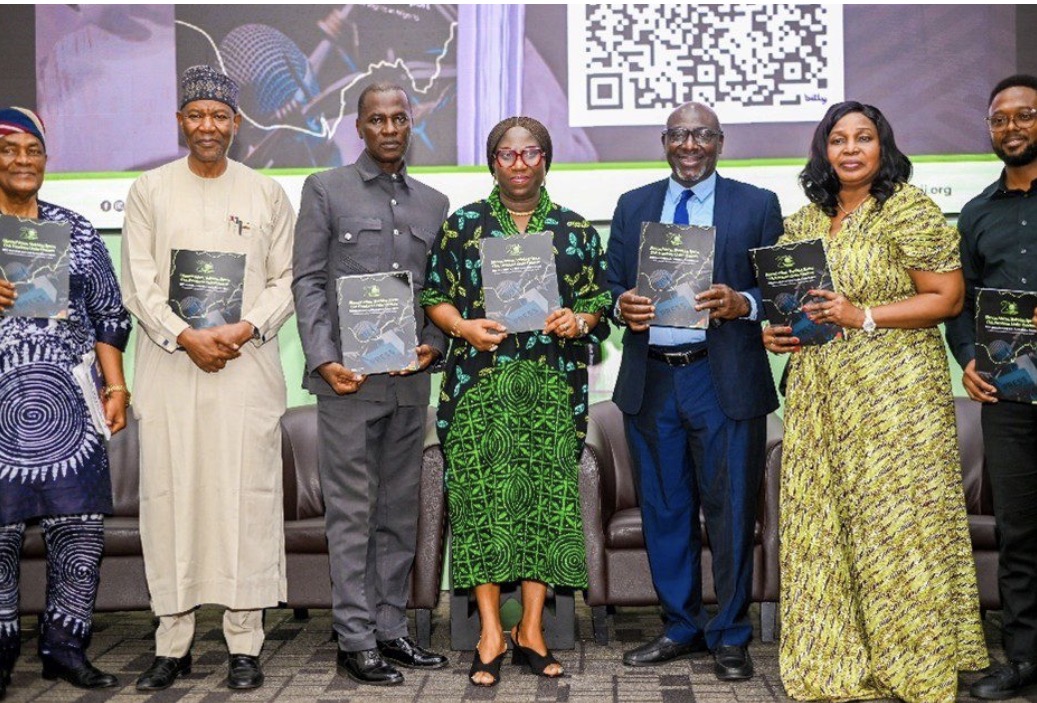

The report shows that Nigeria had 245 incidents of civic space violations in 2025. State actors were involved in 219 of these cases.
These incidents were tracked by monitoring reports from 54 media organisations between January and December 2025.
“Data was collected through continuous monitoring of reports on civic space violations across physical and digital spaces. Every incident was verified by checking with multiple credible sources before being included in the dataset. When more context was needed, Key Informant Interviews (KIIs) were done,” the report stated.
The report noted that incidents reported by different media organisations were counted as one verified incident to avoid duplication.
It explained that the 245 incidents analysed were mentioned in reports from 54 media organisations. This included 16 newspapers with print and online editors, 26 online-only news platforms, 10 television stations, and two radio stations.
The report’s findings showed that Nigeria’s civic space is still under serious pressure, even with the country’s democratic system and constitutional rights.
It also pointed out that the Nigeria Police Force was involved in 118 of the 219 incidents with state actors.



Comments
No comments yet.