Attacks drop but deaths rise in northern Nigeria after 2023 election
While attacks against civilians in northern Nigeria decreased post-election, the number of related deaths surged, particularly in Benue. This report highlights the alarming statistics.
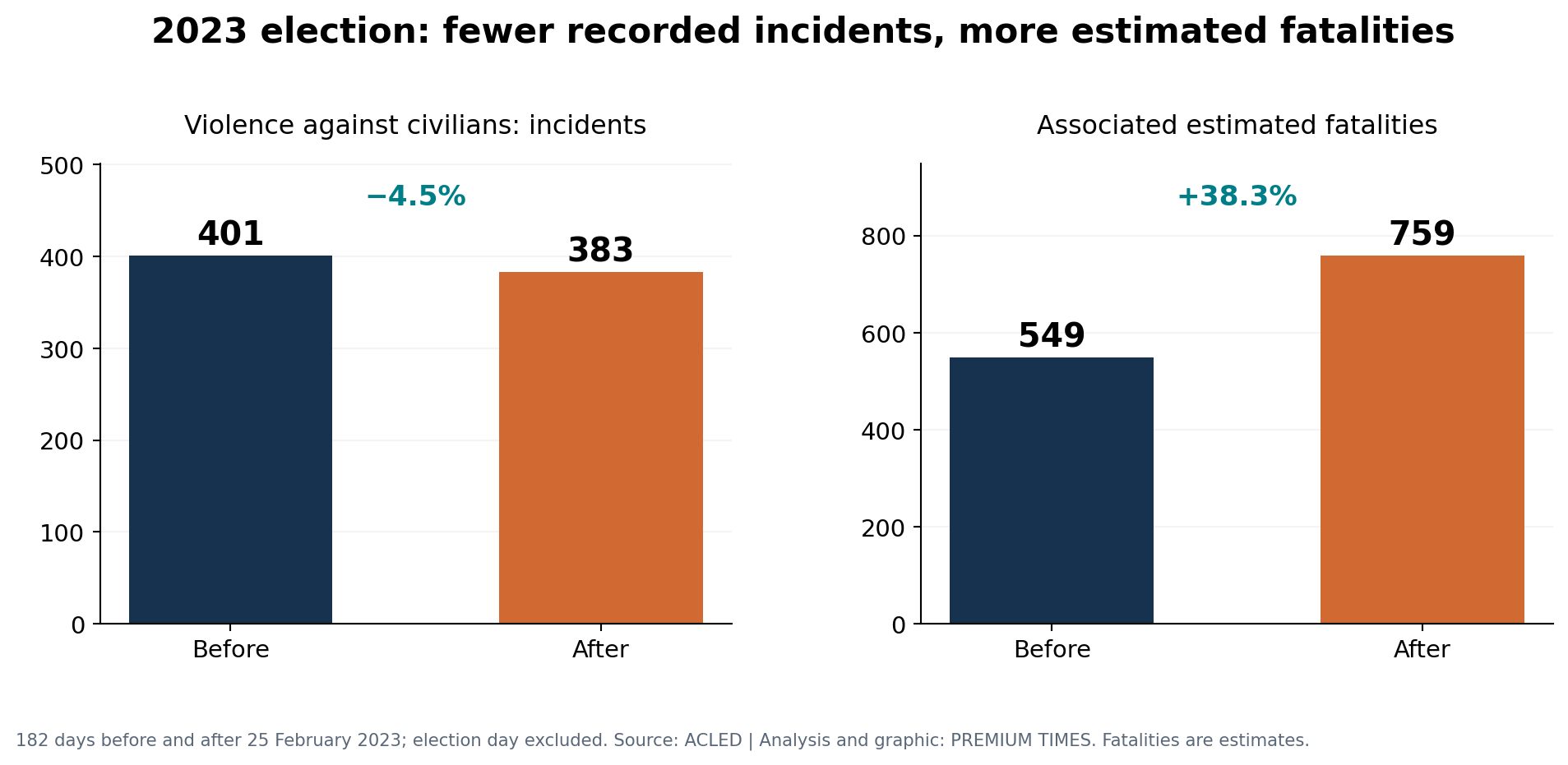
Attacks against civilians went down a bit in seven northern Nigerian states in the six months after the 2023 presidential election. But the number of deaths linked to these attacks went up, according to a report by PREMIUM TIMES.
Data from the Armed Conflict Location & Event Data (ACLED) project shows that violence against civilians dropped from 401 incidents in the six months before the election to 383 afterwards. This is a decrease of 4.5 percent. However, the estimated deaths rose from 549 to 759, which is an increase of 38.3 percent.
Most of the increase in estimated deaths happened in Benue. The number of deaths jumped from 111 before the election to 315 afterwards. This rise of 204 accounted for almost all of the total increase of 210 across the seven states.
The analysis looked at Katsina, Zamfara, Sokoto, Kebbi, Kaduna, Niger, and Benue. It also compared these periods with similar times around the 2015 and 2019 presidential elections, as well as changes in violence during non-election years.
The report shows violence during specific periods. It does not prove that the elections caused the attacks or that the incidents were linked to election activities.
Different patterns across seven states
The drop in recorded incidents after the 2023 election was not the same everywhere. Katsina had 93 incidents before the election and 74 afterwards. Zamfara went from 100 to 86, Kaduna from 72 to 56, and Kebbi from 12 to six.
But in other states, the numbers went up. Sokoto rose from 38 incidents before the election to 58 afterwards, while Benue increased from 45 to 61. Niger stayed nearly the same, with 41 incidents before the election and 42 afterwards.
The estimated deaths did not follow the same trend as the incident counts. In Zamfara, deaths increased from 136 to 154 even though incidents declined. Sokoto saw an increase from 45 to 98, and Benue’s deaths rose from 111 to 315. Fewer recorded attacks do not mean fewer people died.
ACLED’s death figures are estimates based on reported incidents. They should not be seen as confirmed death counts.
What earlier elections show
PREMIUM TIMES also looked at periods around the 2015 and 2019 presidential elections. In the six months before the 23 February 2019 election, ACLED recorded 83 incidents of violence against civilians in the seven states. This number jumped to 147 in the following period, a rise of 77.1 percent.
For the 2015 election, incidents went from 29 to 40. Even though incidents dropped slightly after the 2023 election, they were still much higher than during the same periods around earlier elections. ACLED recorded 69 incidents around the 2015 election, 230 around 2019, and 784 around 2023.
These comparisons show changes in recorded violence. They do not prove that presidential elections caused these increases or decreases. Changes in how conflict is reported over time also play a part in understanding differences between election years.
Katsina and Zamfara after 2019
Katsina had one of the biggest increases in violence in the 2019 comparison. ACLED reported 10 incidents of violence against civilians in the six months before the election and 37 afterwards. The estimated deaths rose from 16 to 161.
Most of the post-election incidents happened in three local government areas: Kankara (10), Batsari (9), and Danmusa (6). Together they made up 25 of the state’s 37 recorded incidents. In Zamfara, incidents went up from 21 to 31, with estimated deaths increasing from 148 to 360. Shinkafi and Kaura Namoda had eight and seven of the post-election incidents respectively.
Violence beyond election periods
The conflict records show major changes outside election years too. In Katsina, ACLED recorded 37 incidents of violence against civilians from 24 February to 24 August 2019. The same period in 2020 had 71 incidents, while the period from 24 February to 23 August 2024 recorded 98.
Zamfara had 31 incidents during the 2019 period and 22 in the same time in 2020. The 2024 comparison showed 130 incidents. Annual records also show much higher incident counts in later years. Across the seven states, ACLED recorded 279 incidents of violence against civilians in 2019, compared to 750 in 2023 and 1,192 in 2024.
These figures reveal that changes in recorded violence were not only during elections. But the number and sources of reports also changed over time. Differences in recorded incidents do not automatically mean changes in the level of violence.
While the ACLED records show how violence changed around elections, reports from INEC and election observers detail how insecurity affected voting in Niger and Katsina during the 2023 presidential election.


How insecurity disrupted voting
The Independent National Electoral Commission (INEC) faced problems in sending staff and materials to Alawa in Shiroro Local Government Area of Niger State. INEC Chairman Mahmood Yakubu linked the delay to security issues, according to a report by PUNCH on election day.
In Katsina, the commission reported that thugs took six Bimodal Voter Accreditation System (BVAS) devices in Safana Local Government Area. Three devices were recovered and replacements were sent out, Mr Yakubu said, as per Channels Television.
Election observer Yiaga Africa noted that polling units were moved in some parts of Shiroro, Mariga, Magama, and Rafi local government areas of Niger State due to attacks. Their election-day situation report raised concerns about how this affected voters’ access to polling places.
Voting arrangements for displaced residents
INEC’s Report of the 2023 General Election states that special voting plans included 155,101 registered voters across 323 polling units and 42 registration areas in five local government areas of Niger State hit by banditry and flooding. Voting took place at camps for internally displaced persons with security support.
Earlier statements gave different numbers. In March 2022, officials pointed out 270 affected polling units in Mariga, Shiroro, Rafi, and Munya. A February 2023 briefing mentioned 247 or 248 units, while the final report showed 323.
These differences might reflect changes in displacement, coverage, or definitions. They cannot be directly compared without looking at the underlying schedules.
The European Union Election Observation Mission raised broader concerns about how much information displaced voters had on registration, voter cards, polling places, and special voting arrangements.
INEC’s report shows the scale of the arrangements but does not clarify how many of the 155,101 registered voters were accredited or voted. To know participation rates, we would need the final polling-unit schedule, accreditation records, and election results.
How we analysed the data
PREMIUM TIMES looked at 17,114 ACLED conflict-event records covering Benue, Kaduna, Katsina, Kebbi, Niger, Sokoto, and Zamfara. Out of these, 9,354 were classified as violence against civilians.
The dataset was provided by ACLED on 14 October 2026 after a request on 13 October. The analysis focused on event date, state, local government area, event classification, and estimated fatality fields. Event identifiers were checked for duplicates.
For each presidential election, incidents recorded in the 182 days before polling day were compared with those in the 182 days after. Election days were not included.
The periods examined were:
2015: 27 September 2014 to 27 March 2015 and 29 March to 26 September 2015.
2019: 25 August 2018 to 22 February 2019 and 24 February to 24 August 2019.
2023: 27 August 2022 to 24 February 2023 and 26 February to 26 August 2023.
The analysis also compared 182-day periods outside presidential election years. For the 2019 comparison, the period ran from 24 February to 24 August. In the leap years 2020 and 2024, the equivalent periods ended on 23 August to keep the same number of days.
The analysis describes changes in recorded incidents and estimated deaths. It does not prove that elections caused these changes or that the attacks were linked to elections. ACLED’s records depend in part on how well conflict is reported. Its death estimates come from reported events and should not be seen as confirmed death counts.






Comments
No comments yet.