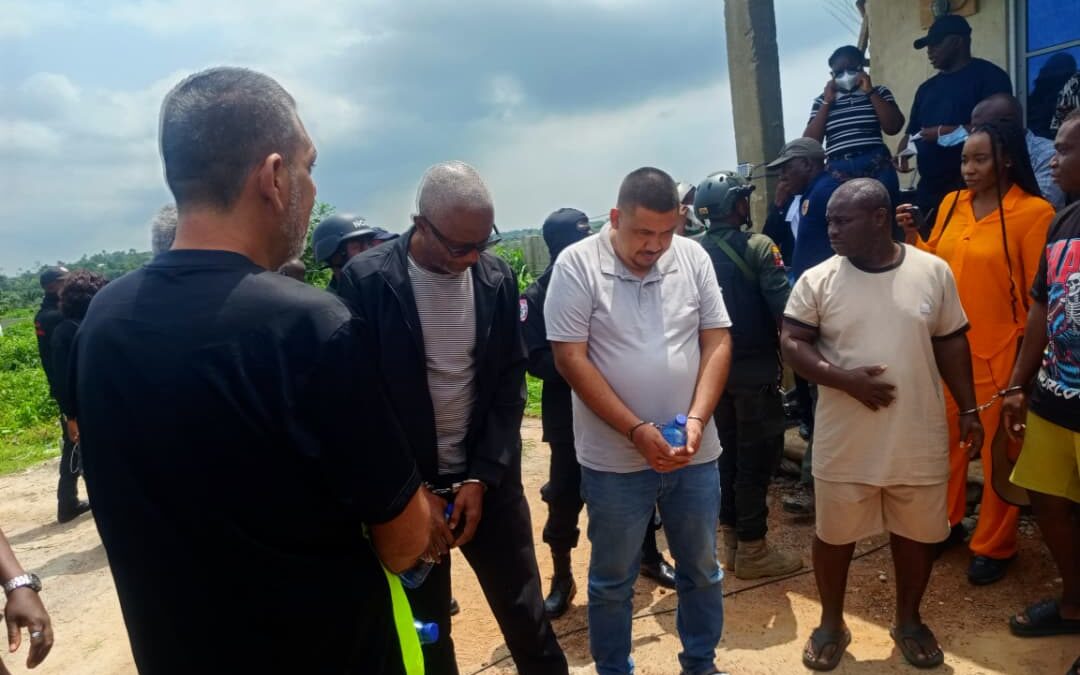
Justice Musa Kakaki of the Federal High Court in Lagos checked out a secret lab in Iloti community, Ogun State, on Wednesday. The National Drug Law Enforcement Agency (NDLEA) claims that 10 people facing drug charges were making and storing large amounts of methamphetamine there.
This visit is part of the trial of three Mexicans and seven Nigerians accused of running the lab. The defendants were brought from the Lagos Correctional Centre. They are Carlos Meza Torrero, Nemecio Martinez Felix, Jesus López Valles, Anochili Innocent, Nwankwo Sunday Christian, Egwuonwu Uchenna Victor, Igwe Abuchi Remijus, Ifeanyichukwu Chibuike Joshua, Omonughwa Kingsley Orike, and Nwobum Emeka Christopher.
At the location, E. Buhari, a lawyer for the prosecution, called Ajilema Anebi as the first witness. Mr Anebi is an expert on secret labs. He had already testified before Mr Kakaki on July 16 about the materials and equipment found at the site where some defendants were arrested.
He told the court that the substances recovered were used to make and store methamphetamine, which was allegedly meant for export outside Nigeria. On Wednesday, he continued his testimony and explained that he and his team identified the substances through analysis. He added that the list of chemicals and equipment he mentioned had already been submitted and accepted as evidence.
During cross-examination, defense lawyer Benson Ndakara asked Mr Anebi to physically point out the items at the site and explain their uses to the court. Mr Ndakara argued that the witness should show the items rather than just refer to previously submitted documents. This request led to an objection from Adekunle Adebajo, head of the NDLEA prosecution team, who took over from Mr Buhari. He stated that the witness had already answered the question and that the list of items found during the operation was in the court documents.
The defense lawyer insisted that identifying the items at the site was necessary for the witness to clearly explain their uses and importance to the case. Mr Kakaki granted this request. Mr Anebi then took the judge and Mr Ndakara around the facility, identifying different chemicals, machines, and bags found at the lab.
As they walked around, the witness explained how the items related to the production process. He also talked about the substances and methods allegedly used there, including alcohol and hydrochloric acid. The inspection of the lab, where the events that led to the case took place, ended with the court setting a new date for further hearings on Friday.
Speaking to reporters after the inspection, Mr Adebajo said the visit allowed the court to see the evidence listed in the prosecution's documents where it was supposedly found. He added that the prosecution requested the inspection to address issues arising from the defense's case.
"The court is here to clarify the application. So whatever we do is about the specific defense the court will rule on Friday," Mr Adebajo said. He mentioned that some exhibits had already been accepted as evidence, but the prosecution would try to submit the rest on Friday.
"Some exhibits have been accepted, but not all, because the environment is not suitable. So the court had to adjourn to Friday," he explained. "We tried to present them today, but due to the environment, we could not."
NDLEA spokesperson Femi Babafemi also spoke to reporters. He called the inspection an important step in the agency's fight against drug trafficking and production. Mr Babafemi noted that the scale of the operation had effects beyond Nigeria due to the potential health and security risks of large-scale drug production.
"It is a landmark for the agency in our drug control efforts because of what was recovered here," he said. "It helps to reduce many public health issues and security problems, not just in Nigeria but in the region and beyond, because of the strength of the drugs made at this facility."
He emphasized that the NDLEA is worried about international drug cartels trying to set up major production sites in Nigeria, especially in the South-west. He pointed out that the cartels seem to be moving their operations away from cities and into forests, making it harder for law enforcement.
"The NDLEA Chairman, General Marwa, has expressed concern that drug syndicates, especially international cartels, seem to be trying to set up major production hubs in the South-west," he said. "They are not doing this in towns but are going into forests for their activities. That is another challenge for the agency."
Mr Babafemi praised the NDLEA prosecution team for their work on the case. The 10 defendants face 11 charges from the NDLEA regarding the alleged setting up and running of a secret lab for methamphetamine production in Ogun State. The prosecution claims the facility produced 2,419.48 kilograms of methamphetamine worth over N480 billion.
The alleged lab is in Mowe Forest, Ijebu East Local Government Area of Ogun State. The NDLEA arrested the defendants at various locations in May, including at the lab. The charges, filed on June 29, include conspiracy, running a drug trafficking organization, transporting and possessing precursor chemicals, producing and possessing methamphetamine, and using property for making illegal drugs.
At their arraignment, all 10 defendants pleaded not guilty. The prosecution wanted to start the trial right away by calling seven witnesses, but the defense opposed this and asked for more time. Mr Kakaki ordered that the defendants be held at the Lagos Correctional Centre. The case was later postponed to July 16 and 22 for hearing bail applications and starting the trial.
After the arrests, NDLEA Chairman Buba Marwa said the involvement of Mexican nationals among the suspects shows how international drug cartels are trying to establish themselves in Nigeria. Mr Marwa, a retired brigadier general, said the agency will keep pursuing drug networks aiming to make Nigeria a hub for illegal drugs.


Drop your comment
No comments yet — be the first to drop the gist 👇